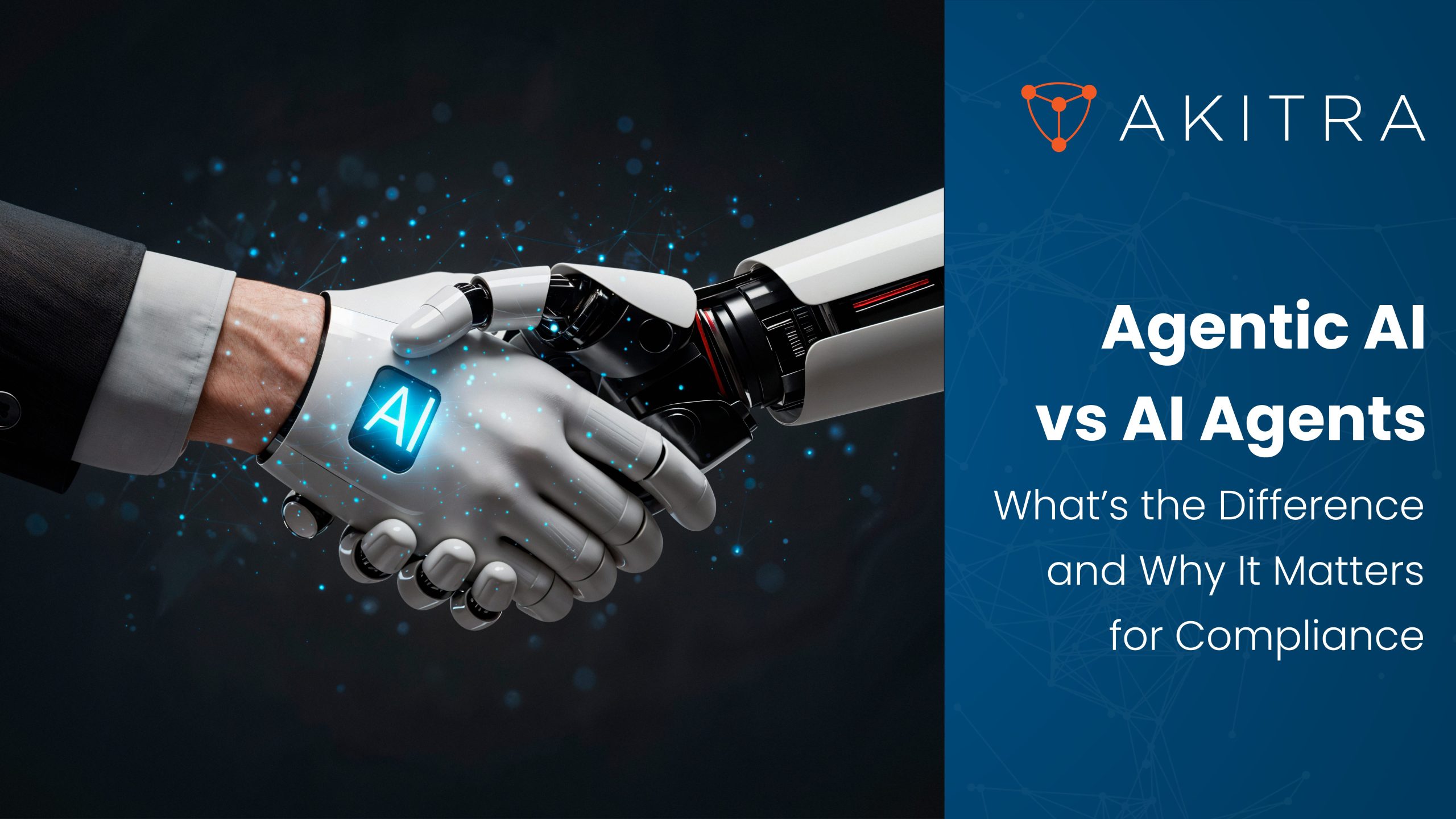
Agentic AI vs AI Agents is more than just a technical comparison—it’s a distinction that could redefine how we think about compliance in an AI-driven world. As artificial intelligence becomes more embedded in how organizations operate, understanding the types of AI we use isn’t just helpful—it’s essential. Why? Because compliance, risk, and accountability depend heavily on the behavior and capabilities of these systems.
In this blog, we’ll unpack the key differences between Agentic AI vs AI Agents, why these differences matter for risk and compliance frameworks, and what the future holds as multi-agent AI frameworks become more common in regulated industries.
What is Agentic AI?
Agentic AI refers to systems that act with purpose, autonomy, and adaptability. Unlike simple task-based bots, agentic systems are often built using multi-agent AI frameworks—a collection of autonomous agents that work together to solve complex problems in real-time. These agents aren’t just following orders; they’re making decisions, learning from outcomes, and coordinating with one another without constant human oversight.
A key characteristic of Agentic AI is its independence. It can evaluate different options, choose actions aligned with long-term goals, and adapt to changing environments—all while operating within a broader mission.
While this is powerful, it also introduces significant Agentic AI risk management challenges. With decentralized decision-making and evolving behaviors, how do you ensure accountability? How do you audit actions taken by an AI system that operates across multiple agents? These are the kinds of questions regulators are starting to ask.
What are AI Agents?
On the other hand, AI agents are typically simpler, rule-based tools designed to perform specific tasks. Think chatbots, workflow assistants, or automated data sorters. These systems execute commands, respond to inputs, and often require human oversight to function correctly.
AI agent use cases are everywhere, including automated ticket routing, virtual shopping assistants, customer support chatbots, and basic predictive models. They’re designed with limited autonomy and operate within well-defined boundaries. You tell them what to do, and they do it—no improvising, no long-term strategy.
Compared to Agentic AI, AI agents are far easier to manage, audit, and control, which is why they’re already common in sectors like finance, healthcare, and logistics, where compliance is critical.
Key Differences Between Agentic AI VS AI Agents
Let’s break down the core distinctions between Agentic AI vs AI Agents:
|
Feature |
Agentic AI |
AI Agents |
|
Autonomy |
High – makes decisions independently |
Low – follows set rules/instructions |
|
Scalability |
Built using multi-agent AI frameworks |
Mostly operates as standalone entities |
|
Adaptability |
Learns and evolves |
Static or minimally adaptive |
|
Use Cases |
Strategic decision-making, optimization |
Task automation, customer interaction |
|
Risk Profile |
High – harder to predict and audit |
Lower – predictable and traceable |
With Agentic AI, you’re not just managing a system; you’re overseeing a dynamic network of autonomous actors. That’s why Agentic AI risk management is a rapidly growing concern, especially in industries with strict governance requirements.
Why Does This Difference Matter for Compliance?
Now, here’s the big question: Why should compliance officers and CISOs care about the difference between Agentic AI and AI Agents?
Because compliance frameworks are built on predictability, transparency, and accountability, and Agentic AI throws a wrench in all three.
For example:
- If an autonomous agent in a multi-agent AI framework makes a decision that violates a regulation, who’s responsible?
- Can you trace the logic behind that decision?
- How do you ensure data privacy across evolving agentic behaviors?
These issues are central to Agentic AI risk management, especially in sectors like finance, healthcare, and critical infrastructure. Traditional tools and processes often fall short when applied to systems that evolve, collaborate, and act independently.
Adding another layer of complexity is the growing comparison of Agentic AI vs generative AI. While generative AI focuses on content creation (like ChatGPT or image generators), Agentic AI is action-oriented. It doesn’t just create—it executes. That execution capability brings with it higher stakes for governance and compliance.
The Future of Compliance with Agentic AI
As Agentic AI becomes more embedded in enterprise systems, compliance strategies must evolve. The future of regulatory alignment lies in systems that can:
- Monitor AI actions in real time
- Detect and flag behavior deviations across multi-agent AI frameworks
- Provide explainable outputs for audits and governance reviews
- Integrate risk modeling into autonomous decision paths
We’re entering a new era where AI doesn’t just support decisions—it makes them. And while AI agents use cases will remain essential for simpler automation tasks, Agentic AI will lead the next wave of innovation.
However, to manage this shift, organizations will need advanced Agentic AI risk management tools and a reimagined compliance approach—one that blends automation with accountability, agility with oversight.
The debate around Agentic AI vs. generative AI will also intensify. Generative tools may generate content, but agentic systems generate actions—and those actions have real-world, often regulated, consequences.
Conclusion
Understanding the distinction between Agentic AI vs AI Agents isn’t just a tech issue—it’s a compliance imperative. As AI becomes more agentic, autonomous, and embedded in mission-critical processes, organizations must rethink how they approach governance, risk, and regulation.
The sooner you understand the difference, the better positioned you’ll be to manage it.
Security, AI Risk Management, and Compliance with Akitra!
In the competitive landscape of SaaS businesses, trust is paramount amidst data breaches and privacy concerns. Akitra addresses this need with its leading AI-powered Compliance Automation platform. Our platform empowers customers to prevent sensitive data disclosure and mitigate risks, meeting the expectations of customers and partners in the rapidly evolving landscape of data security and compliance. Through automated evidence collection and continuous monitoring, paired with customizable policies, Akitra ensures organizations are compliance-ready for various frameworks such as SOC 1, SOC 2, HIPAA, GDPR, PCI DSS, ISO 27001, ISO 27701, ISO 27017, ISO 27018, ISO 9001, ISO 13485, ISO 42001, NIST 800-53, NIST 800-171, NIST AI RMF, FedRAMP, CCPA, CMMC, SOX ITGC, and more such as CIS AWS Foundations Benchmark, Australian ISM and Essential Eight etc. In addition, companies can use Akitra’s Risk Management product for overall risk management using quantitative methodologies such as Factorial Analysis of Information Risks (FAIR) and qualitative methods, including NIST-based for your company, Vulnerability Assessment and Pen Testing services, Third Party Vendor Risk Management, Trust Center, and AI-based Automated Questionnaire Response product to streamline and expedite security questionnaire response processes, delivering huge cost savings. Our compliance and security experts provide customized guidance to navigate the end-to-end compliance process confidently. Last but not least, we have also developed a resource hub called Akitra Academy, which offers easy-to-learn short video courses on security, compliance, and related topics of immense significance for today’s fast-growing companies.
Our solution offers substantial time and cost savings, including discounted audit fees, enabling fast and cost-effective compliance certification. Customers achieve continuous compliance as they grow, becoming certified under multiple frameworks through a single automation platform.
Build customer trust. Choose Akitra TODAY! To book your FREE DEMO, contact us right here.
FAQs
Why does understanding Agentic AI matter for compliance?
Because Agentic AI’s autonomy impacts risk, accountability, and auditability—core pillars of compliance. Without understanding it, compliance gaps are likely.
Can Agentic AI improve audit readiness compared to AI Agents?
Yes, if properly designed. Agentic AI can automate continuous monitoring and risk detection, but it also requires strong controls to remain audit-friendly.
Are AI Agents still relevant in compliance automation?
Absolutely. AI agents are ideal for structured tasks like policy enforcement, document tagging, and access control monitoring—simple, rule-based jobs.
What are some real-world examples of Agentic AI in compliance?
- Continuous compliance monitoring across cloud systems
- AI-driven vendor risk assessments
- Adaptive access management in Zero Trust frameworks
How does Agentic AI handle regulatory updates and changes?
It can adapt through dynamic policy engines or retraining, but only if it’s connected to updated regulatory data sources or a governance layer.
What are the risks of relying on Agentic AI for compliance?
- Lack of explainability
- Rogue decision-making
- Difficulty in tracing actions for audits
- Higher complexity in risk control
How does Agentic AI ensure accountability and transparency?
Through audit logs, explainable AI models, and layered monitoring that captures agent behavior in real time across decision points.
Which industries benefit the most from Agentic AI for compliance?
- Financial services
- Healthcare and life sciences
- Cloud-native tech companies
- Manufacturing with smart factories
How can businesses decide between implementing Agentic AI or AI Agents?
- Choose AI agents for predictable, repetitive compliance tasks.
- Opt for Agentic AI when you need adaptive, strategic compliance capabilities that scale across systems.