HIPAA Compliance Automation for Healthcare Data Protection
Akitra is an agentic AI-native GRC (governance, risk, and compliance) platform purpose-built to simplify HIPAA compliance, automating PHI protection, security control monitoring, evidence collection, and continuous audit readiness for healthcare organizations.
Maintain clear records of AI risks, decisions, controls, and governance activities.
Strengthen AI Risk Management
Identify, assess, and manage AI risks through a consistent governance framework.
Establish Clear Accountability
Define ownership, responsibilities, and oversight across the AI lifecycle.
Build Trust in AI Systems
Show customers and stakeholders that AI is governed through defined, responsible practices.
Create a Scalable AI Governance Foundation
Establish an AI Management System that can evolve with new use cases, technologies, and regulatory expectations.
Support Responsible AI Adoption
Scale AI use with governance guardrails that support responsible development and deployment.
Common HIPAA Compliance Challenges
Even well-prepared healthcare organizations run into recurring obstacles when managing HIPAA compliance – here are the ones we see most often:
Managing PHI Across Multiple Systems
Patient health information is often stored across electronic health records, cloud platforms, applications, and third-party services, making it difficult to maintain consistent visibility and protection.
Performing HIPAA Risk Analysis
Identifying threats, evaluating vulnerabilities, documenting potential impacts, and tracking remediation requires a structured approach aligned with HIPAA Security Rule expectations.
Managing Business Associate Risk
Third-party vendors and business associates that access PHI require ongoing oversight, appropriate agreements, and visibility into security practices that impact healthcare data.
Preparing Evidence for HIPAA Reviews
Gathering policies, access records, security documentation, and control evidence from different systems can make HIPAA assessments time-consuming and difficult to manage.
Maintaining HIPAA Privacy and Security Documentation
Organizations must keep policies, breach notification procedures, workforce training records, privacy practices, and security documentation current as systems and processes evolve.
Detecting Compliance Drift Between Reviews
Changes to user access, systems, vendors, configurations, and security processes can introduce compliance gaps that may go unnoticed between periodic assessments.
HIPAA Requirements and Safeguards at a Glance
HIPAA Compliance - 6 Steps
01
HIPAA Privacy
Rule
Defines how Protected Health Information (PHI) can be accessed, used, and disclosed while giving individuals greater control over their health information.
02
HIPAA Security Rule
Establishes requirements for protecting electronic Protected Health Information (ePHI) through appropriate administrative, physical, and technical security measures.
03
Administrative, Physical, and Technical Safeguards
Establish policies, workforce responsibilities, and security procedures; protect facilities, workstations, and devices; and apply access management, authentication, audit controls, and data protection to secure ePHI.
04
Risk Analysis and Risk Management
Identify potential threats and vulnerabilities, evaluate their impact, and implement measures to reduce risks affecting the confidentiality, integrity, and availability of ePHI.
05
Business Associate Agreements (BAAs)
Define responsibilities between covered entities and business associates that create, receive, maintain, or transmit PHI on behalf of healthcare organizations.
06
Breach Notification Requirements
Maintain processes for identifying, responding to, and reporting breaches of unsecured PHI according to HIPAA requirements.
01
HIPAA Privacy Rule
Defines how Protected Health Information (PHI) can be accessed,
used, and disclosed while giving individuals greater control over
their health information.
02
HIPAA Security Rule
Establishes requirements for protecting electronic Protected
Health Information (ePHI) through appropriate administrative,
physical, and technical security measures.
03
Administrative, Physical, and Technical Safeguards
Establish policies, workforce responsibilities, and security
procedures; protect facilities, workstations, and devices; and
apply access management, authentication, audit controls, and
data protection to secure ePHI.
04
Risk Analysis and Risk Management
Identify potential threats and vulnerabilities, evaluate their
impact, and implement measures to reduce risks affecting the
confidentiality, integrity, and availability of ePHI.
05
Business Associate Agreements (BAAs)
Define responsibilities between covered entities and business
associates that create, receive, maintain, or transmit PHI on
behalf of healthcare organizations.
06
Breach Notification Requirements
Maintain processes for identifying, responding to, and reporting
breaches of unsecured PHI according to HIPAA requirements.
How Akitra Automates HIPAA Compliance
Akitra uses agentic AI to automate the core workflows behind HIPAA compliance, reducing manual effort across evidence collection, monitoring, and reporting.
Automated Evidence Collection
Collect and organize compliance evidence from connected systems to reduce manual evidence gathering and simplify HIPAA audit preparation.
HIPAA Risk Management
Identify compliance risks, assign ownership, track remediation activities, and maintain visibility into risk status across the organization.
Security Control Monitoring
Continuously monitor relevant security controls and identify changes that may impact HIPAA compliance readiness.
Policy and Procedure Management
Centralize HIPAA policies, procedures, approvals, and compliance documentation in one place as systems and processes evolve.
Business Associate and Third-Party Risk Management
Track vendor relationships, security requirements, and third-party risks associated with access to Protected Health Information (PHI).
Audit-Ready Reporting
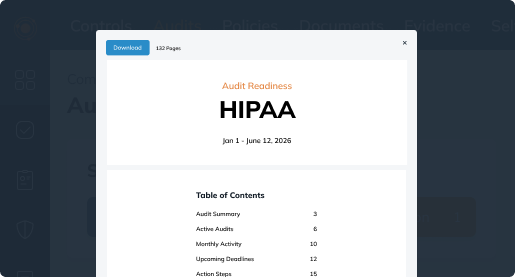
Bring together controls, evidence, risks, and compliance activities into organized reports for assessments and internal reviews.
Why Teams Choose Akitra for HIPAA Compliance
Here are the reasons healthcare organizations consistently choose Akitra to manage HIPAA compliance:
AI-Supported Compliance Workflows
Use AI-supported workflows to connect evidence collection, monitoring, and reporting in one place.
One Platform for Multiple Frameworks
Manage HIPAA alongside SOC 2, ISO 27001, and other frameworks in a single system while reusing applicable controls and evidence.
Focused on Healthcare Data Protection
Manage HIPAA workflows around the requirements of protecting Protected Health Information (PHI), including risks, controls, evidence, and compliance activities.
Ownership and Accountability Built In
Assign clear responsibility for risks, controls, and remediation activities so compliance tasks move forward without unnecessary delays.
Built for Covered Entities and Business Associates
Organize HIPAA responsibilities for healthcare organizations and for the service providers that handle PHI on their behalf.
Continuous Readiness, Not Last-Minute Prep
Keep HIPAA evidence and control status current as systems, access, and vendors change, instead of rebuilding documentation before each assessment.
HIPAA is a U.S. law that requires healthcare-related businesses to safeguard Protected Health Information (PHI) from unauthorized access or disclosure.
We care about your privacy We use cookies to operate this website, improve usability, personalize your experience, and improve our marketing. Your privacy is important to us and we will never sell your data. Privacy Policy.