Artificial Intelligence has moved from buzzword to backbone in record time. It’s diagnosing diseases, fighting financial fraud, streamlining factories, and even helping governments serve citizens. However, as AI infiltrates every corner of business and society, the conversation has shifted from “what can we build?” to “how do we build it responsibly?”
That’s where AI Governance comes in.
Most organizations now recognize the need for governance, but here’s the catch: many of the existing frameworks are too generic. They talk about fairness, accountability, and transparency in broad strokes—but they rarely go deep into what these mean in a hospital, a bank, or a government office.
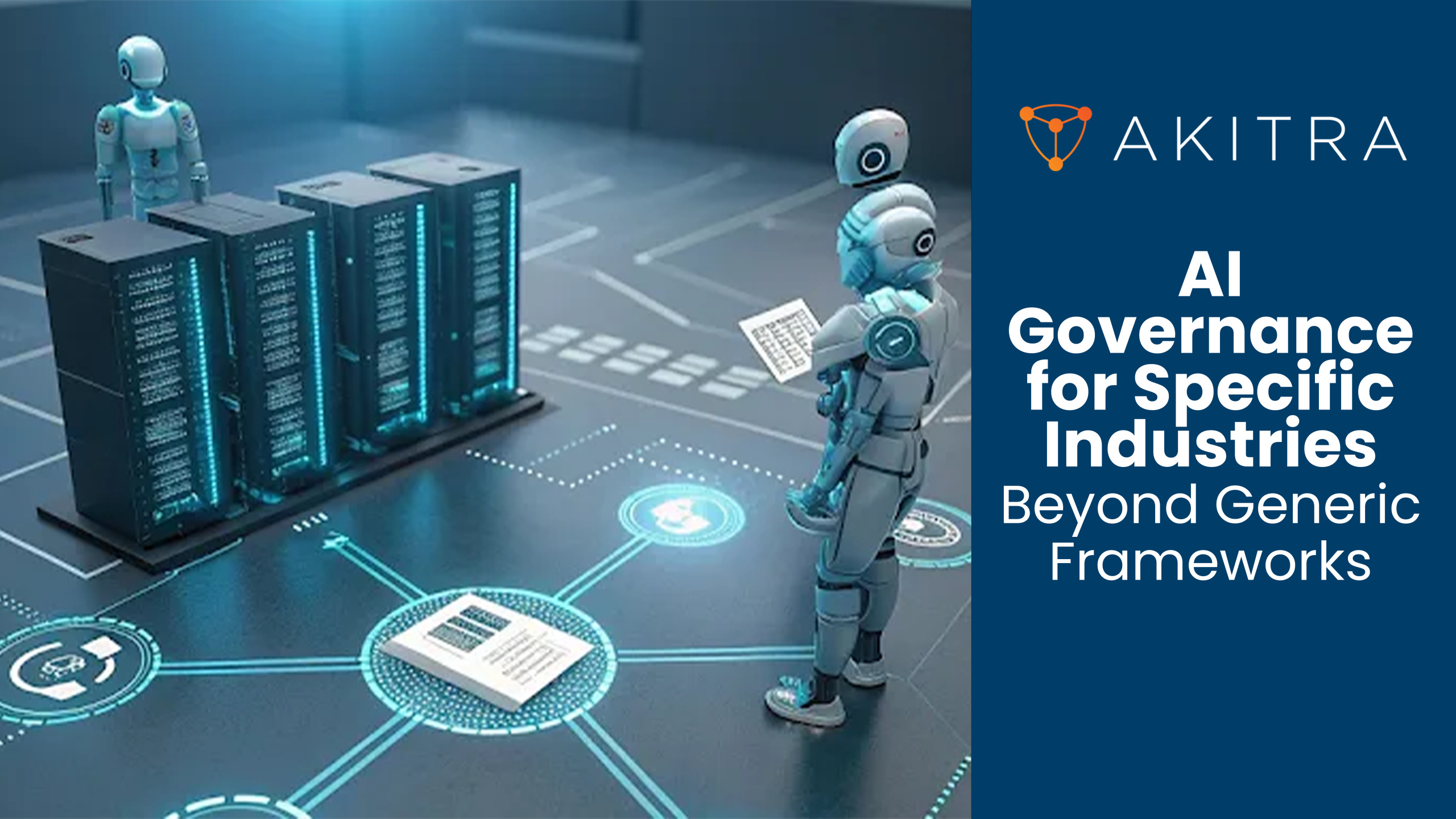
If AI is to work safely and effectively, AI governance must move beyond one-size-fits-all and into the realities of specific industries.
Why “Generic” Governance Isn’t Enough
Think about it:
- A doctor using an AI tool to support diagnoses faces very different risks than a factory manager using AI to predict equipment failures.
- A bank that relies on AI for credit decisions needs stricter AI compliance controls than a retailer using AI for inventory forecasts.
This is one of the biggest AI governance challenges, generic frameworks simply can’t capture the complexity of different industries. They’re a good starting point, but they’re not the full story.
What Industry-Specific AI Governance Looks Like
Let’s explore how tailoring governance makes a difference across sectors:
1. Healthcare: Trust and Patient Safety
AI is transforming medicine—from scanning X-rays to predicting disease outbreaks. But if an algorithm misfires, lives are at risk. That’s why AI governance best practices in healthcare must prioritize patient safety, rigorous validation, and compliance with privacy laws such as HIPAA.
2. Finance: Compliance Above All
In banking, AI decides who gets loans, flags suspicious transactions, and even powers trading. Mistakes here aren’t just costly—they’re illegal. AI compliance in finance necessitates explainable models, unbiased decision-making, and audit trails that can withstand regulatory scrutiny.
3. Manufacturing: Efficiency Meets Security
Factories operate on optimization, and AI enables them to run faster, smarter, and safer. But a poorly governed AI model could halt production or expose trade secrets. Here, AI governance best practices focus on resilience, cybersecurity, and data integrity.
4. Government and Public Sector: Accountability to Citizens
When governments utilize AI for citizen services or law enforcement, the stakes are high, as public trust is a significant concern. Citizens want transparency—why was this decision made, and by whom? AI Governance in this space must emphasize explainability and fairness, backed by clear accountability.
Common AI Governance Challenges
Even though industries differ, some hurdles show up everywhere:
- Bias and fairness: How do you ensure AI decisions don’t discriminate?
- Transparency: Can you explain how the AI arrived at its conclusion in language that non-experts can understand?
- Accountability: Who’s on the hook when something goes wrong?
- Adaptability: How do you update governance as models evolve and regulations become more stringent?
These challenges are why industry-specific AI regulations are emerging worldwide. Regulators understand that the risks in a hospital aren’t the same as those in a factory.
Best Practices for Industry-Specific AI Governance
So, how do organizations go beyond the generic playbook? Here are some proven steps:
1. Map Your Regulations
Stay updated with industry-specific AI regulations. For example, the EU AI Act designates certain systems—like healthcare AI—as “high-risk,” requiring stricter compliance obligations.
2. Keep Humans in the Loop
AI should augment, not replace human judgment. Establish governance workflows that enable individuals to validate, override, or audit AI decisions.
3. Build Cross-Functional Teams
AI governance is a shared responsibility. Involve legal, compliance, business, and technical teams to create stronger, well-rounded oversight.
4. Monitor Continuously
Models evolve, data shifts, and risks emerge over time. Implement continuous monitoring to ensure governance remains effective and adaptive.
5. Go Beyond Compliance
Regulations set the minimum standard. Embed ethical principles—such as fairness, privacy, and transparency—into your AI design and deployment.
From Risk Management to Competitive Advantage
It’s easy to think of AI Governance as a burden—more paperwork, more oversight. However, the truth is that strong governance can be a significant competitive advantage. Customers trust transparent companies. Regulators favor proactive businesses. And industries that embrace AI governance best practices not only reduce risk but move faster with confidence.
The shift we’re seeing now is clear: governance isn’t just about avoiding penalties; it’s about creating the conditions for AI to thrive responsibly.
Conclusion
The future of AI Governance is specialized, not generic. Each industry carries its own risks, pressures, and opportunities. By addressing AI governance challenges with tailored frameworks, aligning with industry-specific AI regulations, and committing to AI compliance alongside ethical principles, organizations can move beyond fear and unlock real innovation.
Security, AI Risk Management, and Compliance with Akitra!
In the competitive landscape of SaaS businesses, trust is paramount amidst data breaches and privacy concerns. Akitra addresses this need with its leading AI-powered Compliance Automation platform. Our platform empowers customers to prevent sensitive data disclosure and mitigate risks, meeting the expectations of customers and partners in the rapidly evolving landscape of data security and compliance. Through automated evidence collection and continuous monitoring, paired with customizable policies, Akitra ensures organizations are compliance-ready for various frameworks such as SOC 1, SOC 2, HIPAA, GDPR, PCI DSS, ISO 27001, ISO 27701, ISO 27017, ISO 27018, ISO 9001, ISO 13485, ISO 42001, NIST 800-53, NIST 800-171, NIST AI RMF, FedRAMP, CCPA, CMMC, SOX ITGC, and more such as CIS AWS Foundations Benchmark, Australian ISM and Essential Eight etc. In addition, companies can use Akitra’s Risk Management product for overall risk management using quantitative methodologies such as Factorial Analysis of Information Risks (FAIR) and qualitative methods, including NIST-based for your company, Vulnerability Assessment and Pen Testing services, Third Party Vendor Risk Management, Trust Center, and AI-based Automated Questionnaire Response product to streamline and expedite security questionnaire response processes, delivering huge cost savings. Our compliance and security experts provide customized guidance to navigate the end-to-end compliance process confidently. Last but not least, we have also developed a resource hub called Akitra Academy, which offers easy-to-learn short video courses on security, compliance, and related topics of immense significance for today’s fast-growing companies.
Our solution offers substantial time and cost savings, including discounted audit fees, enabling fast and cost-effective compliance certification. Customers achieve continuous compliance as they grow, becoming certified under multiple frameworks through a single automation platform.
Build customer trust. Choose Akitra TODAY! To book your FREE DEMO, contact us right here.
FAQs
Why do industries need specific AI governance frameworks instead of generic ones?
Generic frameworks provide high-level principles but don’t address the unique risks of each sector. For example, healthcare AI must prioritize patient safety and privacy, while finance AI must meet strict compliance and audit requirements. Industry-specific governance ensures tailored protections.
What are the biggest AI governance challenges organizations face today?
Common challenges include managing bias in algorithms, ensuring transparency and explainability, meeting AI compliance regulations, and adapting governance models as AI systems evolve.
4. How do industry-specific AI regulations affect businesses?
Industry-specific AI regulations, such as HIPAA in healthcare or FINRA requirements in finance, impose specialized compliance obligations. Organizations must map their AI governance to these regulations to stay compliant and avoid penalties.
What are some AI governance best practices companies can follow?
Best practices include creating cross-functional governance teams, embedding human oversight into AI workflows, continuously monitoring models, and aligning policies with ethical standards as well as industry-specific AI regulations.