If your organization works with the U.S. Department of Defense (DoD) or plans to bid on federal defense contracts, achieving CMMC compliance is no longer optional, it’s a business requirement.
With the rollout of CMMC 2.0 and its implementation across DoD contracts, contractors are expected to demonstrate that they can adequately protect Controlled Unclassified Information (CUI) and Federal Contract Information (FCI). Organizations that fail to meet these cybersecurity requirements risk losing contract opportunities, facing compliance issues, and exposing sensitive defense data to cyber threats.
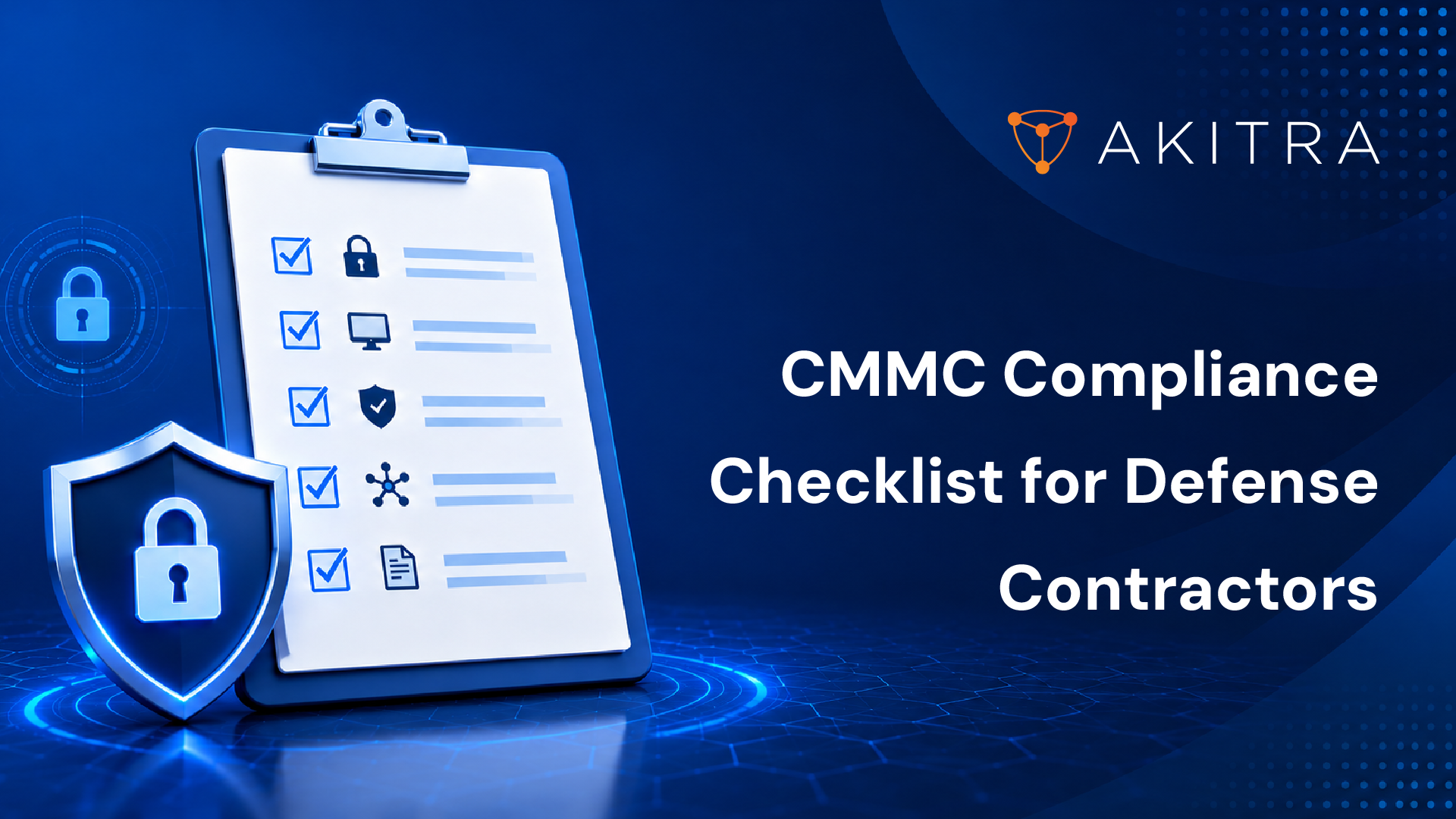
This CMMC compliance checklist provides a practical, step-by-step roadmap to help defense contractors prepare for certification, strengthen cybersecurity, and remain audit-ready throughout 2026.
What Is CMMC Compliance?
The Cybersecurity Maturity Model Certification (CMMC) is the U.S. Department of Defense’s cybersecurity framework designed to ensure that contractors protect sensitive government information throughout the Defense Industrial Base (DIB).
CMMC 2.0 simplifies the original model into three maturity levels:
- Level 1 – Foundational
- Level 2 – Advanced
- Level 3 – Expert
Most defense contractors handling Controlled Unclassified Information (CUI) will need to achieve CMMC Level 2, which aligns with the 110 security requirements in NIST SP 800-171 Rev. 2.
Why Every Defense Contractor Needs a CMMC Compliance Checklist
Preparing for CMMC involves much more than implementing technical security controls. Organizations must demonstrate that they have:
- Security policies and documented procedures
- Technical safeguards
- Continuous monitoring
- Employee security awareness
- Incident response capabilities
- Vendor risk management
- Audit evidence supporting every implemented control
Without a structured checklist, it’s easy to overlook critical requirements that could delay certification.
Complete CMMC Compliance Checklist (2026)
Use the following checklist as your roadmap toward successful CMMC certification.
1. Determine Your Required CMMC Level
The first step is understanding which CMMC level applies to your organization.
Ask yourself:
✔ Do you handle only Federal Contract Information (FCI)?
✔ Do you store or process Controlled Unclassified Information (CUI)?
✔ Does your contract explicitly require CMMC certification?
For most defense contractors working with CUI, Level 2 is the required certification.
2. Identify and Classify Sensitive Information
You cannot protect data if you don’t know where it exists.
Create an inventory of:
- Controlled Unclassified Information (CUI)
- Federal Contract Information (FCI)
- Servers
- Endpoints
- Cloud services
- Databases
- File shares
- Backup systems
- Third-party platforms
Data classification forms the foundation of every compliance program.
3. Define the Scope of Your CMMC Environment
One of the biggest mistakes organizations make is including unnecessary systems in the assessment.
Clearly identify:
- Users accessing CUI
- Devices storing CUI
- Applications processing CUI
- Cloud environments
- Network segments
- Third-party systems
Reducing scope can significantly simplify compliance and lower implementation costs.
4. Perform a Gap Assessment Against NIST SP 800-171
A comprehensive gap assessment identifies which security controls are already implemented and where improvements are needed.
Evaluate all 110 security requirements across areas including:
- Access Control
- Audit and Accountability
- Configuration Management
- Incident Response
- Risk Assessment
- Security Assessment
- Media Protection
- Identification and Authentication
- Personnel Security
- Physical Protection
- System Integrity
- System and Communications Protection
Document every identified gap and prioritize remediation based on risk.
5. Implement Access Controls
Access control is one of the most scrutinized areas during a CMMC assessment.
Ensure that you:
- Enforce least privilege access
- Remove inactive accounts
- Require Multi-Factor Authentication (MFA)
- Implement role-based access control
- Review privileged access regularly
- Restrict remote access appropriately
Regular user access reviews help maintain compliance over time.
6. Secure Endpoints, Networks, and Cloud Systems
Protect every system within your CMMC scope. Your security baseline should include:
- Endpoint Detection and Response (EDR)
- Firewalls
- Secure network segmentation
- Antivirus and anti-malware protection
- Secure VPN access
- Patch management
- Vulnerability scanning
- Secure cloud configurations
- Encryption for data in transit and at rest
These controls reduce attack surfaces while satisfying multiple CMMC practices.
7. Develop and Maintain Security Policies
Assessors expect documented policies, not just technical controls. Maintain current policies for:
- Information Security
- Access Control
- Incident Response
- Risk Management
- Asset Management
- Configuration Management
- Change Management
- Backup and Recovery
- Acceptable Use
- Vendor Management
Policies should be reviewed and updated regularly.
8. Train Employees on Cybersecurity Awareness
Human error remains one of the leading causes of security incidents. Provide regular training covering:
- Phishing attacks
- Password hygiene
- Social engineering
- Handling Controlled Unclassified Information
- Incident reporting
- Remote work security
- Data protection responsibilities
Keep attendance records and training evidence for audits.
9. Establish an Incident Response Program
Every defense contractor should be prepared before an incident occurs. Your incident response plan should include:
- Detection procedures
- Reporting processes
- Roles and responsibilities
- Containment steps
- Recovery procedures
- Lessons learned
- Communication plans
Conduct tabletop exercises periodically to validate readiness.
10. Monitor Systems Continuously
CMMC is not a one-time project. Implement continuous monitoring through:
- Centralized logging
- Security Information and Event Management (SIEM)
- Vulnerability management
- Configuration monitoring
- Continuous control validation
- Automated compliance monitoring
Continuous visibility helps identify risks before they become compliance issues.
11. Manage Third-Party and Supplier Risks
Many cybersecurity incidents originate from vendors. Your CMMC compliance program should include:
- Vendor risk assessments
- Security questionnaires
- Contractual security requirements
- Continuous vendor monitoring
- Annual security reviews
- Third-party access management
Supply chain security is becoming increasingly important across the Defense Industrial Base.
12. Maintain Documentation and Audit Evidence
One of the most common reasons organizations struggle during assessments is missing documentation.
Maintain evidence such as:
- Policies
- Procedures
- System configurations
- Access review reports
- Vulnerability scan reports
- Security training records
- Risk assessments
- Asset inventories
- Incident logs
- Backup reports
- Change management records
Collecting evidence continuously makes assessments significantly easier.
13. Conduct Internal Readiness Assessments
Before your official assessment, perform an internal review to verify:
- Controls are operating effectively.
- Required documentation is complete.
- Security practices match documented policies.
- Technical evidence is readily available.
- Gaps have been remediated.
A mock assessment helps uncover issues before an official audit.
14. Prepare for Your CMMC Assessment
Once your environment is ready:
- Confirm assessment scope.
- Review supporting documentation.
- Validate technical controls.
- Ensure evidence is current.
- Verify policy approvals.
- Prepare key personnel for assessor interviews.
Good preparation reduces delays and improves assessment outcomes.
Common CMMC Compliance Mistakes to Avoid
Many organizations delay certification because of avoidable mistakes. Common pitfalls include:
- Treating CMMC as an IT-only initiative
- Poor documentation practices
- Weak asset inventories
- Incomplete CUI identification
- Infrequent access reviews
- Delayed patching
- Lack of continuous monitoring
- Ignoring vendor security
- Waiting until the audit to collect evidence
Avoiding these issues can save significant time and effort during certification.
How Compliance Automation Simplifies the CMMC Checklist
Completing a CMMC compliance checklist manually often involves spreadsheets, screenshots, emails, and repetitive evidence collection. As environments grow, maintaining compliance becomes increasingly difficult.
Akitra Andromeda® compliance automation platform can streamline the process by:
- Automatically collecting audit evidence
- Continuously monitoring security controls
- Mapping controls to CMMC and NIST SP 800-171
- Tracking remediation tasks
- Managing policies and documentation
- Providing real-time compliance dashboards
- Simplifying internal reviews and external assessments
Automation reduces manual effort, improves consistency, and helps organizations stay audit-ready throughout the year instead of preparing only when an assessment is scheduled.
Final Thoughts
Achieving CMMC compliance isn’t simply about passing an assessment, it’s about building a resilient cybersecurity program that protects sensitive defense information and strengthens trust with the Department of Defense.
By following this CMMC compliance checklist, defense contractors can approach certification methodically, reduce compliance gaps, and establish continuous security practices rather than relying on last-minute audit preparation.
Organizations that combine strong governance, well-documented processes, continuous monitoring, and automation are better positioned to meet CMMC requirements, respond to evolving cyber threats, and remain competitive in the Defense Industrial Base.
If your organization is preparing for CMMC certification, adopting a continuous compliance approach today can significantly reduce audit effort and help maintain compliance long after certification is achieved.
Security, AI Risk Management, and Compliance with Akitra!
In the competitive landscape of SaaS businesses, trust is paramount amidst data breaches and privacy concerns. Akitra addresses this need with its leading Agentic AI-powered Compliance Automation platform. Our platform empowers customers to prevent sensitive data disclosure and mitigate risks, meeting the expectations of customers and partners in the rapidly evolving landscape of data security and compliance. Through automated evidence collection and continuous monitoring, paired with customizable policies, Akitra ensures organizations are compliance-ready for various frameworks such as SOC 1, SOC 2, HIPAA, GDPR, PCI DSS, ISO 27001, ISO 27701, ISO 27017, ISO 27018, ISO 9001, ISO 13485, ISO 42001, NIST 800-53, NIST 800-171, NIST AI RMF, FedRAMP, CCPA, CMMC, SOX ITGC, and more such as CIS AWS Foundations Benchmark, Australian ISM and Essential Eight etc. In addition, companies can use Akitra’s Risk Management product for overall risk management using quantitative methodologies such as Factorial Analysis of Information Risks (FAIR) and qualitative methods, including NIST-based for your company, Vulnerability Assessment and Pen Testing services, Third Party Vendor Risk Management, Trust Center, and AI-based Automated Questionnaire Response product to streamline and expedite security questionnaire response processes, delivering huge cost savings. Our compliance and security experts provide customized guidance to navigate the end-to-end compliance process confidently. Last but not least, we have also developed a resource hub called Akitra Academy, which offers easy-to-learn short video courses on security, compliance, and related topics of immense significance for today’s fast-growing companies.
Our solution offers substantial time and cost savings, including discounted audit fees, enabling fast and cost-effective compliance certification. Customers achieve continuous compliance as they grow, becoming certified under multiple frameworks through a single automation platform.
Build customer trust. Choose Akitra TODAY!To book your FREE DEMO, contact us right here.
FAQ’S
Who needs CMMC compliance?
Organizations within the Defense Industrial Base that handle Federal Contract Information (FCI) or Controlled Unclassified Information (CUI) under DoD contracts may need to comply with CMMC requirements, depending on contract obligations.
Is CMMC Level 2 based on NIST SP 800-171?
Yes. CMMC Level 2 aligns with the 110 security requirements defined in NIST SP 800-171 Rev. 2, making it the primary benchmark for organizations handling CUI.
How long does CMMC certification take?
The timeline depends on your current cybersecurity maturity. Organizations with mature security programs may complete readiness in a few months, while others may require longer to remediate gaps, document controls, and prepare for assessment.
Can compliance be automated?
Many aspects of CMMC compliance can be automated, including evidence collection, control monitoring, policy management, compliance reporting, and continuous risk tracking. Automation helps reduce manual work while improving audit readiness.