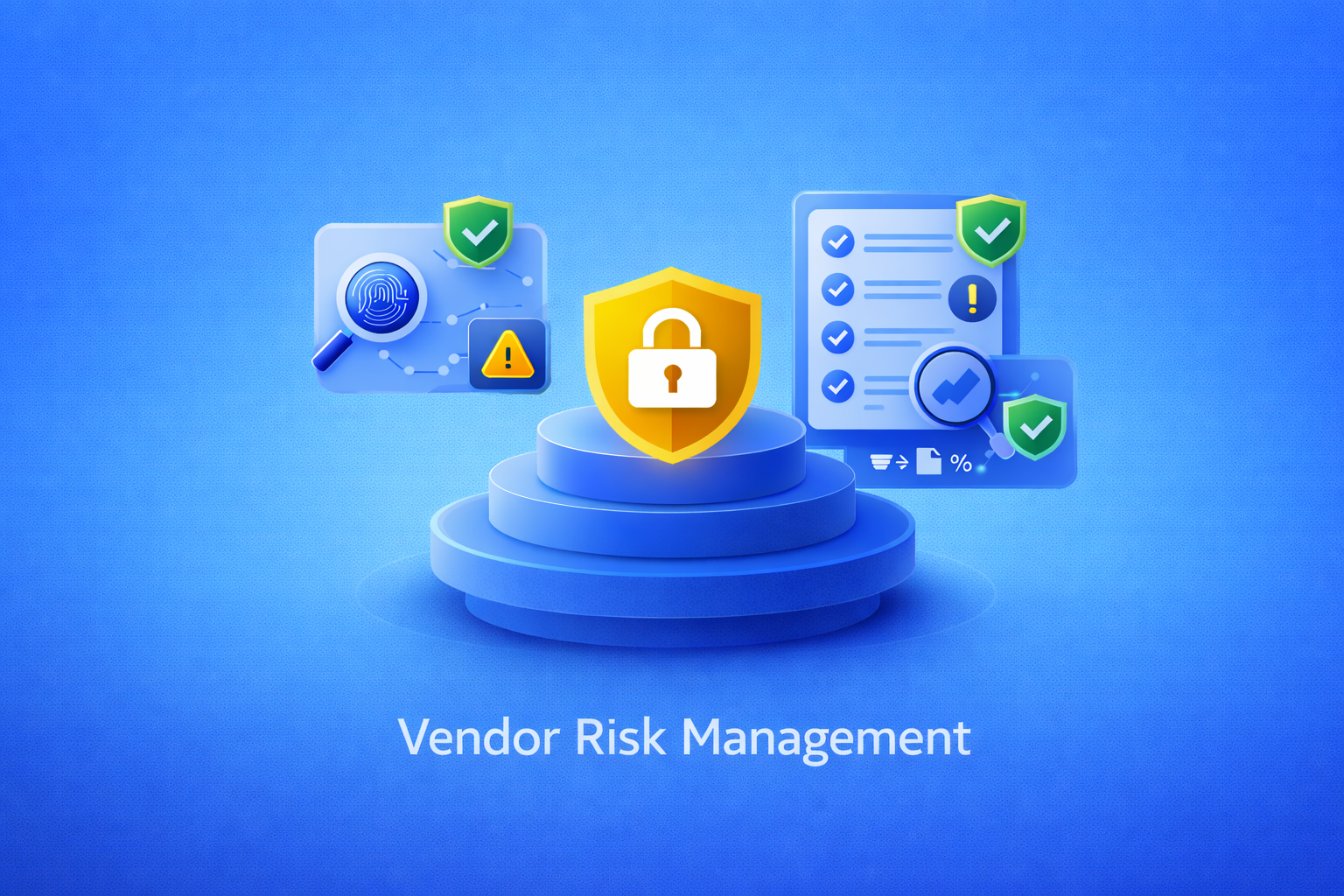
Every modern business, regardless of size or industry, relies heavily on vendors, third-party SaaS tools, cloud platforms, and service providers. This interconnected ecosystem delivers speed and scale, but it also opens the door to hidden risks you can’t afford to ignore.
That’s where vendor risk integration becomes a game-changer for your Enterprise Risk Management (ERM) program.
When vendor risks are treated as a separate checklist or an annual procurement formality, organizations face blind spots. But when vendor risk is fully embedded into your ERM framework, you gain visibility, accountability, and control over an environment that is constantly shifting.
In this blog, we’ll explore why integrating Vendor Risk Management (VRM) into ERM is essential, what an effective integration looks like, and the steps organizations can take to build a unified, resilient approach to third-party risks.
Why Vendor Risk Integration Matters More Than Ever
Third-party relationships are no longer limited to outsourced payroll or occasional consulting. Today, everything, from your CRM and email security to data processing, AI tools, identity systems, and payment platforms, runs on third-party services.
This creates dependency risk and concentration risk that organizations often overlook.
Here’s why vendor risk integration is more critical than ever:
1. Third-party incidents are increasing
A large percentage of data breaches now originate not inside companies, but through vendors.
A single compromised vendor can lead to:
- Data leakage
- Operational disruption
- Compliance violations
- Financial penalties
- Reputational damage
This ripple effect makes integrated oversight essential.
2. Compliance expectations have evolved
Regulators across industries, including HIPAA, PCI DSS, ISO 27001, SOC 2, GDPR, and others, require strict vendor oversight.
But compliance is no longer just about documentation. Auditors expect organizations to show:
- Ongoing monitoring
- Risk-based vendor tiering
- Continuous assessment
- Proof of remediation
These requirements align naturally with ERM workflows, making integration the logical next step.
3. Siloed teams mean siloed risks
If your procurement team owns vendor onboarding, infosec handles questionnaires, and ERM handles governance reporting…
But these functions don’t talk to each other?
You’re dealing with fragmented risk visibility.
Integration fixes that by creating a single risk story, connecting:
- Vendor criticality
- Control gaps
- Operational impact
- Business continuity risks
- Cyber threats
- Regulatory exposure
- Financial dependencies
4. ERM depends on accurate upstream data
Without visibility into vendor risk, ERM functions operate with incomplete insights.
Integrating both allows risk leaders to understand how external risks affect:
- Business objectives
- Strategic initiatives
- Enterprise risk appetite
- Organizational resilience
Benefits of Integrating Vendor Risk Management with ERM
Bringing VRM under the ERM umbrella unlocks multiple long-term benefits:
-
360° visibility into third-party risk
Integration provides executives with a single view of all internal and external risks, helping them prioritize effectively.
-
Better alignment with enterprise objectives
Vendor risks are evaluated based on their impact on core goals: expansion, innovation, customer trust, compliance, and revenue.
-
Faster decision-making
When VRM data is embedded in ERM dashboards, leadership gains real-time insights rather than waiting for monthly or quarterly reports.
-
Stronger governance
Integrated oversight ensures vendor risks are continuously monitored, reducing surprises.
-
Improved audit readiness
-
- A unified risk environment makes it easier to produce:
- Evidence of assessments
- Risk ratings
- Mitigation plans
- Vendor documentation
-
Reduced operational risk
From supply chain disruptions to cybersecurity events, integrated vendor intelligence helps organizations act before risks escalate.
Key Components of Vendor Risk Integration in ERM
Let’s break down what strong integration looks like in practice.
1. Centralized Vendor Inventory
Start by maintaining a single source of truth for all third-party vendors. This inventory should capture:
- Vendor name and category
- Services provided
- Data access level
- Integrations
- Associated business processes
- Contract owners
- Renewal dates
- Compliance documentation
A centralized system helps avoid duplication, blind spots, and unmanaged shadow vendors.
2. Risk-Based Vendor Tiering
Not all vendors carry equal risk. A risk-tiering model helps you categorize vendors based on:
- Criticality of services
- Sensitivity of data handled
- Access to customer data
- Security posture
- Regulatory exposure
Typical tiers include:
- Tier 1: High-risk vendors
- Tier 2: Moderate-risk vendors
- Tier 3: Low-risk vendors
Integrating these tiers into ERM allows enterprise risk teams to prioritize oversight and allocate resources more effectively.
3. Unified Risk Scoring and Impact Analysis
Once vendors are tiered, ERM teams should integrate VRM scoring into broader enterprise risk scoring.
This ensures all vendor risks are:
- Quantified
- Mapped to business processes
- Linked to enterprise risks
- Connected to KRIs (Key Risk Indicators)
This unified scoring model improves risk forecasting and reporting accuracy.
4. Cross-Functional Collaboration
Vendor risk integration thrives on collaboration across:
- IT
- Infosec
- Procurement
- Legal
- Finance
- Business units
- Compliance teams
Each team provides insights that shape the vendor risk picture. ERM then consolidates this information for enterprise-wide decision-making.
5. Continuous Monitoring Instead of Annual Reviews
Annual vendor assessments are no longer enough. Today’s risk environment demands:
- Ongoing monitoring
- Real-time alerts
- Automated signals
- Continuous evidence updates
- Incident notifications
- Live performance data
When these updates feed directly into ERM dashboards, risk leaders can act faster and more intelligently.
6. Integration with Contract & Performance Management
Contracts often contain critical risk-related obligations:
- SLAs
- Security requirements
- Data-processing addendums
- Continuity guarantees
- Termination clauses
ERMs must be able to evaluate how these obligations impact overall enterprise risk.
7. Incident & Remediation Tracking
When a vendor fails a security test or experiences an incident, your ERM program should:
- Log the event
- Assign severity
- Trigger workflow actions
- Track remediation progress
- Update vendor risk scores
This creates a documented audit trail and strengthens accountability.
A Step-by-Step Framework for Integrating VRM into ERM
Here is a practical roadmap organizations can follow:
Step 1: Identify all vendors and existing risk owners
Build a consolidated inventory that captures what exists today.
Step 2: Define risk categories
Include cybersecurity, operational, financial, legal, compliance, reputational, and strategic risks.
Step 3: Build a vendor tiering model
Align vendor criticality with enterprise risk appetite.
Step 4: Standardize vendor assessment questionnaires
Ensure consistency in evaluating controls.
Step 5: Map vendor risks to enterprise risks
Link third-party risks to enterprise-wide risk categories.
Step 6: Integrate monitoring data into ERM tools
Real-time visibility is essential for proactive governance.
Step 7: Establish cross-functional governance committees
Regularly review vendor risk exposure and escalation triggers.
Step 8: Automate where possible
Automation reduces human error, improves coverage, and standardizes workflows.
Common Challenges and How to Overcome Them
Even mature organizations face hurdles when integrating VRM into ERM:
1. Incomplete vendor inventory
Solution: Conduct quarterly vendor discovery exercises.
2. Lack of cross-team alignment
Solution: Define clear ownership and communication pathways.
3. Manual processes slow down risk reviews
Solution: Adopt automated workflows for monitoring, scoring, and tracking.
4. Poor visibility into subcontractors (fourth parties)
Solution: Require transparency from primary vendors and include contractual obligations.
5. Difficulty connecting VRM data with ERM dashboards
Solution: Use standardized reporting structures and risk scoring models.
How Vendor Risk Integration Strengthens Resilience
An ERM program is only as strong as its weakest link. By embedding vendor oversight into enterprise risk processes, organizations achieve better preparedness for outages, as they know exactly which business processes will be impacted if a vendor fails. This approach also ensures a stronger compliance posture, where vendor controls directly support frameworks and regulations such as SOC 2, ISO 27001, HIPAA, HITRUST, PCI DSS, GDPR, and more.
In addition, vendor risk integration enables improved business continuity planning by allowing risk teams to build contingency plans that align closely with the enterprise-wide continuity strategy. It also fosters stronger trust with customers, as a well-managed and transparent supply chain becomes a key competitive advantage, particularly in regulated industries. Most importantly, it leads to reduced financial risk, ensuring that failures of critical vendors do not escalate into costly operational disruptions.
Overall, integration ensures your enterprise risk strategy reflects the real-world interconnectedness of today’s business environment.
Conclusion
For SaaS and cloud-first companies, operationalizing ERM turns risk management from a reactive scramble into a proactive, continuous, and scalable process. With clearer visibility, stronger cloud security, and faster compliance, ERM helps teams move quickly without sacrificing trust or safety. In a world where risks evolve daily, ERM ensures your SaaS business stays resilient, reliable, and ready for growth.
Security, AI Risk Management, and Compliance with Akitra!
In the competitive landscape of SaaS businesses, trust is paramount amidst data breaches and privacy concerns. Akitra addresses this need with its leading Agentic AI-powered Compliance Automation platform. Our platform empowers customers to prevent sensitive data disclosure and mitigate risks, meeting the expectations of customers and partners in the rapidly evolving landscape of data security and compliance. Through automated evidence collection and continuous monitoring, paired with customizable policies, Akitra ensures organizations are compliance-ready for various frameworks such as SOC 1, SOC 2, HIPAA, GDPR, PCI DSS, ISO 27001, ISO 27701, ISO 27017, ISO 27018, ISO 9001, ISO 13485, ISO 42001, NIST 800-53, NIST 800-171, NIST AI RMF, FedRAMP, CCPA, CMMC, SOX ITGC, and more such as CIS AWS Foundations Benchmark, Australian ISM and Essential Eight etc. In addition, companies can use Akitra’s Risk Management product for overall risk management using quantitative methodologies such as Factorial Analysis of Information Risks (FAIR) and qualitative methods, including NIST-based for your company, Vulnerability Assessment and Pen Testing services, Third Party Vendor Risk Management, Trust Center, and AI-based Automated Questionnaire Response product to streamline and expedite security questionnaire response processes, delivering huge cost savings. Our compliance and security experts provide customized guidance to navigate the end-to-end compliance process confidently. Last but not least, we have also developed a resource hub called Akitra Academy, which offers easy-to-learn short video courses on security, compliance, and related topics of immense significance for today’s fast-growing companies.
Our solution offers substantial time and cost savings, including discounted audit fees, enabling fast and cost-effective compliance certification. Customers achieve continuous compliance as they grow, becoming certified under multiple frameworks through a single automation platform.
Build customer trust. Choose Akitra TODAY!To book your FREE DEMO, contact us right here.
FAQ’S
Why is vendor risk integration important?
Because third-party incidents, data breaches, and service disruptions can directly impact enterprise objectives, compliance, resilience, and reputation.
How often should vendor risks be assessed?
High-risk vendors should be monitored continuously, while medium and low-risk vendors require periodic updates depending on their tier.
Who owns vendor risk within ERM?
Typically, it is shared across procurement, infosec, and compliance, but ERM teams consolidate and govern it.
How do organizations integrate VRM data into ERM dashboards?
Through unified scoring models, continuous monitoring signals, standardized reporting, and integrated risk platforms.