Artificial intelligence is rapidly becoming a core part of business operations. Organizations are using AI to automate decisions, improve customer experiences, enhance productivity, and gain competitive advantages.
However, as AI adoption grows, so do concerns around governance, transparency, accountability, security, and compliance.
This is where ISO 42001 implementation becomes important.
ISO/IEC 42001 is the world’s first international standard designed specifically for Artificial Intelligence Management Systems (AIMS). It provides organizations with a structured framework to govern AI responsibly, manage risks, and demonstrate trustworthiness.
This guide explains what ISO 42001 implementation involves, the key requirements of an AI Management System, and the steps organizations can follow to achieve certification readiness.
Key Takeaways
- ISO/IEC 42001 is the first international standard for AI Management Systems (AIMS).
- ISO 42001 implementation helps organizations establish governance, accountability, and risk management for AI systems.
- The framework requires organizations to identify AI use cases, assess risks, implement controls, and continuously monitor AI performance.
- Successful implementation requires cross-functional collaboration between compliance, security, legal, risk, and business teams.
- Compliance automation platforms such as Akitra can help streamline evidence collection, policy management, risk assessments, and audit readiness activities.
What Is ISO 42001 Implementation?
ISO 42001 implementation is the process of establishing, operating, monitoring, and continuously improving an Artificial Intelligence Management System (AIMS) in accordance with ISO/IEC 42001 requirements.
The framework helps organizations:
- Govern AI responsibly
- Manage AI-related risks
- Improve transparency and accountability
- Define roles and responsibilities
- Monitor AI performance
- Demonstrate regulatory and stakeholder trust
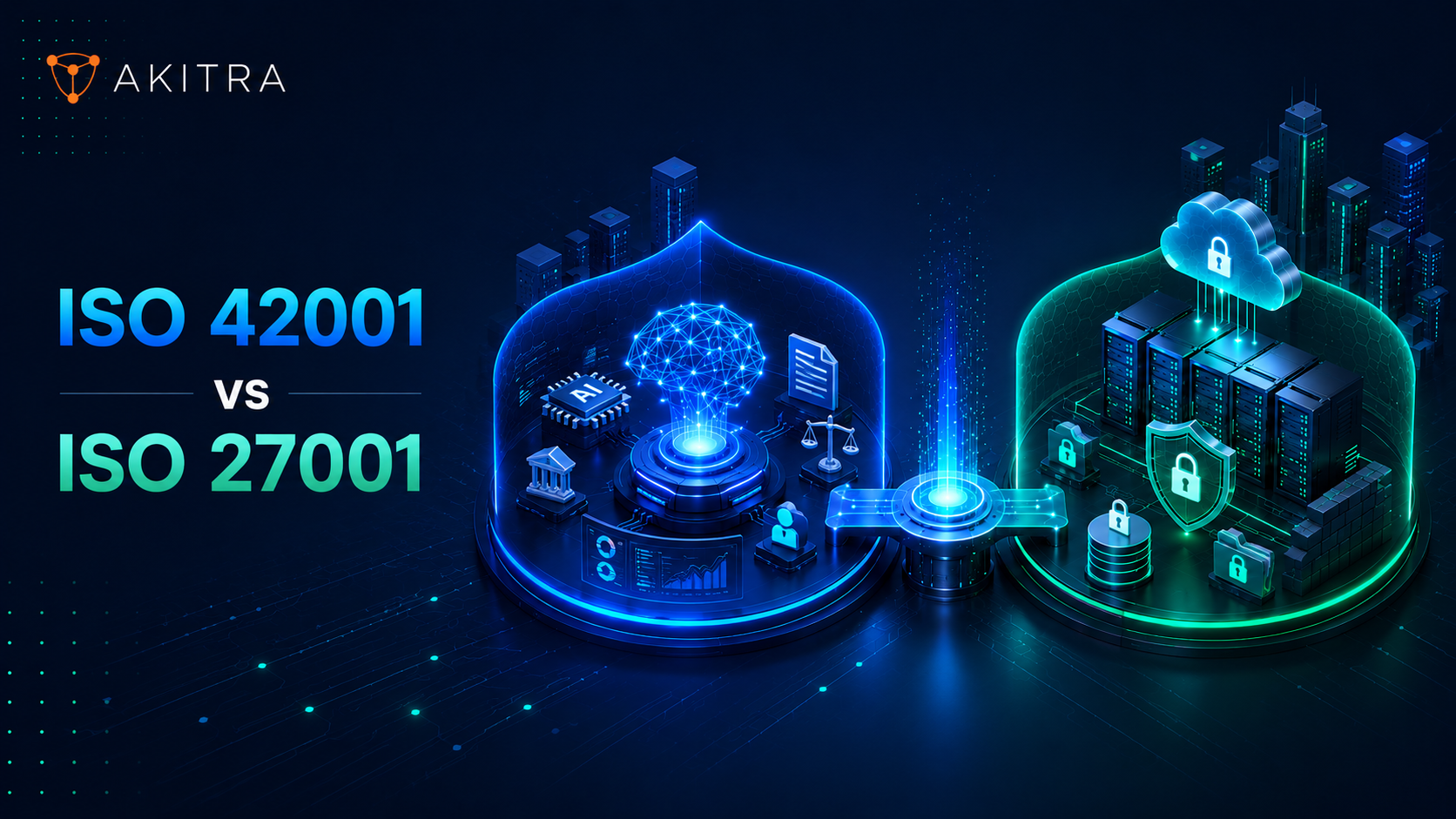
Much like ISO 27001 provides a framework for information security management, ISO 42001 provides a framework for managing AI systems throughout their lifecycle.
The goal is not simply certification. The goal is to ensure AI technologies are used safely, ethically, and effectively.
Why ISO 42001 Matters
Organizations are increasingly deploying AI in areas such as:
- Customer service
- Fraud detection
- Healthcare diagnostics
- Financial decision-making
- Human resources
- Supply chain optimization
- Software development
Without proper governance, AI systems can introduce risks such as:
- Bias and discrimination
- Inaccurate outputs
- Lack of transparency
- Privacy violations
- Security vulnerabilities
- Regulatory non-compliance
ISO 42001 helps organizations establish a repeatable governance framework that reduces these risks while supporting innovation.
Key Requirements of an AI Management System
Before starting ISO 42001 implementation, organizations should understand the core elements of an Artificial Intelligence Management System.
Governance and Leadership
Leadership must establish policies, objectives, and accountability structures for AI governance.
This includes:
- Defining AI governance responsibilities
- Assigning ownership
- Establishing oversight mechanisms
- Supporting continuous improvement
AI Risk Management
Organizations must identify, evaluate, and manage risks associated with AI systems.
Examples include:
- Ethical risks
- Security risks
- Privacy risks
- Operational risks
- Regulatory risks
AI Lifecycle Management
The framework requires organizations to govern AI throughout its lifecycle, including:
- Design
- Development
- Deployment
- Monitoring
- Retirement
Monitoring and Improvement
Organizations must continuously assess AI performance, effectiveness, and compliance.
Monitoring activities should identify:
- Emerging risks
- Control failures
- Performance issues
- Opportunities for improvement
Step-by-Step ISO 42001 Implementation Guide
Step 1: Define an AI Governance Structure
The first step in ISO 42001 implementation is establishing governance.
Organizations should clearly define:
- AI ownership
- Roles and responsibilities
- Decision-making authority
- Oversight committees
- Escalation procedures
Effective governance creates accountability and ensures AI-related decisions are consistently managed across the organization.
Step 2: Identify AI Systems and Use Cases
Many organizations underestimate how many AI systems are already in use.
Create an inventory that includes:
- AI applications
- Machine learning models
- Generative AI tools
- Third-party AI services
- Business processes using AI
For each AI system, document:
- Purpose
- Owner
- Inputs and outputs
- Data sources
- Dependencies
- Business impact
This inventory becomes the foundation of your AI Management System.
Step 3: Conduct AI Risk Assessments
Risk management is a core component of ISO 42001 implementation.
Organizations should assess risks related to:
- Bias and fairness
- Explainability
- Security
- Privacy
- Data quality
- Model performance
- Regulatory obligations
Risk assessments should evaluate:
- Likelihood of occurrence
- Potential impact
- Existing controls
- Residual risk levels
Documented risk assessments provide evidence of responsible AI governance.
Step 4: Establish Policies and Controls
Organizations must develop policies that guide the responsible use of AI.
Common policy areas include:
- AI governance
- Acceptable AI use
- Data management
- Model development
- Third-party AI oversight
- Security requirements
- Human oversight requirements
Controls should be implemented to ensure policies are consistently followed. These controls should be documented, monitored, and periodically reviewed.
Step 5: Monitor AI Performance and Compliance
AI governance does not end after deployment.
Organizations must continuously monitor:
- Accuracy and effectiveness
- Security controls
- Bias indicators
- Regulatory compliance
- Policy adherence
- Operational performance
Regular reviews help identify issues before they become significant risks. Continuous monitoring also supports ongoing certification readiness.
Step 6: Prepare for ISO 42001 Certification
Once governance, risk management, policies, and monitoring processes are established, organizations can begin preparing for certification.
Typical preparation activities include:
- Internal audits
- Management reviews
- Control testing
- Evidence collection
- Documentation reviews
- Corrective action tracking
Certification auditors will evaluate whether the AI Management System is properly designed and operating effectively.
Organizations with mature documentation and evidence management processes typically experience smoother audits.
Common ISO 42001 Implementation Challenges
While the framework provides clear guidance, organizations often encounter challenges during implementation.
Lack of AI Visibility
Many organizations do not have a complete inventory of AI systems.
Shadow AI tools and decentralized deployments can create governance gaps.
Evolving Regulatory Requirements
AI regulations continue to evolve globally.
Organizations must align governance programs with changing legal and compliance expectations.
Cross-Functional Coordination
AI governance requires collaboration across:
- Security
- Compliance
- Risk
- Legal
- Technology
- Business teams
Without clear ownership, implementation efforts can stall.
Documentation Burdens
Maintaining policies, risk assessments, evidence, and audit documentation manually can be time-consuming and difficult to scale.
How Akitra Helps Simplify ISO 42001 Implementation
Building an AI Management System requires ongoing governance, risk management, documentation, and monitoring.
Akitra helps organizations streamline ISO 42001 implementation through:
- Automated evidence collection
- Centralized risk management
- Policy lifecycle management
- Audit-ready reporting
- Continuous compliance monitoring
- AI governance workflows
In addition, Akitra’s AI-powered Policy Analysis capabilities help organizations review, assess, and improve policies faster. Acting as an AI compliance co-worker, it assists teams in identifying gaps, strengthening governance documentation, and accelerating readiness efforts.
By automating many of the manual activities associated with compliance programs, organizations can focus more on governing AI effectively and less on administrative overhead.
Conclusion
As AI adoption continues to accelerate, organizations need structured governance frameworks to manage risk, ensure accountability, and build trust.
ISO 42001 provides a comprehensive framework for establishing an Artificial Intelligence Management System that supports responsible AI use throughout the lifecycle of AI technologies.
Successful ISO 42001 implementation requires more than documentation. It requires governance, risk management, monitoring, and continuous improvement.
Organizations that begin building these capabilities today will be better positioned to meet regulatory expectations, demonstrate AI accountability, and confidently scale their AI initiatives in the future.
Security, AI Risk Management, and Compliance with Akitra!
In the competitive landscape of SaaS businesses, trust is paramount amidst data breaches and privacy concerns. Akitra addresses this need with its leading Agentic AI-powered Compliance Automation platform. Our platform empowers customers to prevent sensitive data disclosure and mitigate risks, meeting the expectations of customers and partners in the rapidly evolving landscape of data security and compliance. Through automated evidence collection and continuous monitoring, paired with customizable policies, Akitra ensures organizations are compliance-ready for various frameworks such as SOC 1, SOC 2, HIPAA, GDPR, PCI DSS, ISO 27001, ISO 27701, ISO 27017, ISO 27018, ISO 9001, ISO 13485, ISO 42001, NIST 800-53, NIST 800-171, NIST AI RMF, FedRAMP, CCPA, CMMC, SOX ITGC, and more such as CIS AWS Foundations Benchmark, Australian ISM and Essential Eight etc. In addition, companies can use Akitra’s Risk Management product for overall risk management using quantitative methodologies such as Factorial Analysis of Information Risks (FAIR) and qualitative methods, including NIST-based for your company, Vulnerability Assessment and Pen Testing services, Third Party Vendor Risk Management, Trust Center, and AI-based Automated Questionnaire Response product to streamline and expedite security questionnaire response processes, delivering huge cost savings. Our compliance and security experts provide customized guidance to navigate the end-to-end compliance process confidently. Last but not least, we have also developed a resource hub called Akitra Academy, which offers easy-to-learn short video courses on security, compliance, and related topics of immense significance for today’s fast-growing companies.
Our solution offers substantial time and cost savings, including discounted audit fees, enabling fast and cost-effective compliance certification. Customers achieve continuous compliance as they grow, becoming certified under multiple frameworks through a single automation platform.
Build customer trust. Choose Akitra TODAY!To book your FREE DEMO, contact us right here.
FAQ’S
Who should implement ISO 42001?
Organizations that develop, deploy, manage, or rely on AI systems can benefit from ISO 42001 implementation, particularly those operating in regulated industries or high-risk environments.
Is ISO 42001 certification mandatory?
No. ISO 42001 certification is voluntary. However, it can help organizations demonstrate responsible AI governance and strengthen stakeholder trust.
How long does ISO 42001 implementation take?
Implementation timelines vary depending on organizational size, AI maturity, and existing governance practices. Many organizations spend several months establishing policies, controls, risk assessments, and documentation.
What are the benefits of ISO 42001 implementation?
Benefits include improved AI governance, stronger risk management, increased transparency, regulatory readiness, stakeholder trust, and better oversight of AI systems throughout their lifecycle.