Compliance isn’t a once-a-year activity; it’s a continuous discipline. Yet, many organizations still manage policies and controls manually, using spreadsheets, shared drives, and endless email chains. This approach not only increases compliance risk but also drains productivity and slows audit readiness.
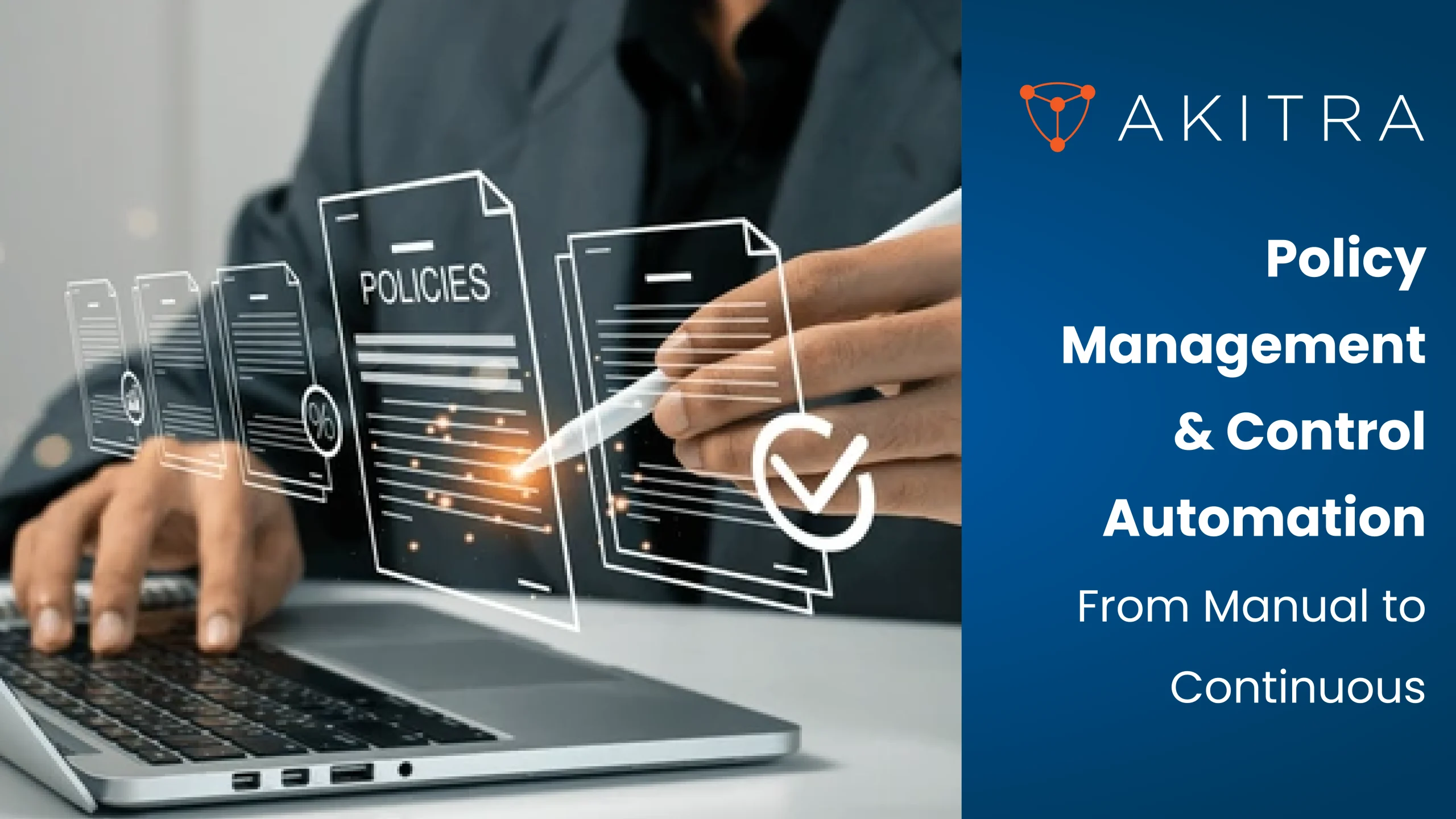
Policy Management Automation is changing that. By unifying policy lifecycle management, control mapping, and evidence collection into a single automated system, enterprises can achieve continuous compliance, where every control, policy, and procedure stays current, enforced, and audit-ready at all times.
Let’s explore how policy management and control automation are reshaping compliance for the modern enterprise.
The Challenges with Manual Policy Management
Manual policy management is inherently reactive.
Teams often scramble to locate the latest policy versions, track acknowledgments, or prove compliance during audits.
Common pain points include:
- Version chaos – Multiple copies of the same policy circulate across teams, creating inconsistencies.
- Siloed updates – Compliance, HR, and IT work in isolation, leading to outdated or conflicting policies.
- Limited visibility – No central dashboard to monitor which controls or policies are outdated or non-compliant.
- Audit fatigue – Endless email threads and manual evidence collection slow down readiness.
This reactive cycle can expose organizations to compliance gaps, reputational risks, and potential penalties.
What Is Policy Management Automation?
Policy Management Automation integrates policies, controls, and evidence workflows into an intelligent, centralized system. It automates the creation, approval, distribution, acknowledgment, and linking of policies to relevant compliance frameworks (such as SOC 2, ISO 27001, HIPAA, or GDPR).
Key Capabilities of Policy Management Automation:
- Centralized Repository: Store, version, and access all policies in one place.
- Automated Workflows: Approvals, reviews, and renewals occur automatically according to predefined schedules.
- Control Mapping: Link policies directly to compliance frameworks and controls.
- Real-Time Monitoring: Track policy adherence, control performance, and audit readiness dashboards.
- Employee Acknowledgment Tracking: Automatically collect and record staff acknowledgments for compliance verification.
When paired with control automation, these features enable organizations to transition from manual documentation to a proactive, continuous compliance model.
How Policy & Control Automation Work Together
Policy management defines the what and why of compliance; control automation delivers the how.
For example, a policy might state:
“All access to financial systems must be reviewed quarterly.”
A control automation system ensures that this review happens automatically, collecting access data, flagging anomalies, and storing results as evidence.
By connecting policy management automation with control automation, organizations can:
- Align every policy with real-time operational data
- Detect non-compliance instantly
- Automatically update auditors with live evidence
- Eliminate manual audit prep
This integrated approach establishes continuous compliance, a living ecosystem where governance isn’t static but adaptive.
The Business Benefits of Policy Management Automation
1. Continuous Compliance
Instead of racing to meet deadlines, teams maintain audit readiness every day. Automated systems ensure that policies and controls evolve alongside regulations and business changes.
2. Audit Efficiency
Audit requests that once took weeks can now be fulfilled in hours. Automated control testing and evidence collection minimize human error and manual follow-ups.
3. Regulatory Agility
When frameworks like ISO 27001:2022 or SOC 2 Type II updates are released, automated mapping quickly identifies impacted policies, so teams can update and communicate them instantly.
4. Risk Reduction
Automation minimizes oversight risks by ensuring that all policies are consistently reviewed and enforced across departments.
5. Operational Productivity
Employees spend less time on admin work and more on value-driven tasks. Compliance teams become strategic partners, not just audit responders.
Implementing Policy Management Automation: A Step-by-Step Approach
Transitioning to automation requires careful planning. Here’s a five-step roadmap used by leading compliance automation platforms:
Step 1: Assess Your Current Posture
Identify existing policies, frameworks, and tools. Map out redundancies, outdated documents, and bottlenecks in policy reviews.
Step 2: Choose an Integrated Automation Platform
Select a compliance automation platform that supports multi-framework alignment, AI-powered mapping, and automated workflows.
Step 3: Centralize and Digitize Policies
Migrate all documents into a unified repository. Ensure metadata tagging for ownership, version, and framework relevance.
Step 4: Connect Controls and Evidence Sources
Integrate systems such as HRIS, IAM, or cloud providers to automate control testing and evidence collection.
Step 5: Enable Continuous Monitoring
Establish real-time dashboards to visualize compliance health, track control status, and trigger alerts for policy expirations or exceptions.
Key Features to Look for in a Policy Management Automation Tool
When evaluating automation software, prioritize these must-have capabilities:
|
Feature |
Why It Matters |
|
AI-Powered Control Mapping |
Automatically aligns policies with frameworks like SOC 2, ISO 27001, and HIPAA. |
|
Automated Policy Lifecycle |
Manages drafting, review, approval, and expiration reminders. |
|
Evidence Automation |
Collects proof directly from integrated systems for each control. |
|
Version Control |
Maintains a single source of truth for every document. |
|
Custom Dashboards |
Offers visual insights into compliance posture and control health. |
|
Integration Library |
Connects with cloud, HR, and identity systems for continuous monitoring. |
|
AI-Powered Policy Update |
AI reviews policies, flags misalignments, and suggests updates to meet the latest standards. |
Why Continuous Compliance Is the Future
Regulations are evolving faster than ever. Manual processes can’t keep up with the speed of modern digital ecosystems. Continuous compliance, powered by policy management and control automation, ensures your business is not only compliant today but stays compliant tomorrow.
The future of compliance will be:
- Agentic – AI that learns from control data and adapts policies automatically.
- Unified – A single pane of glass for compliance, risk, and trust.
- Transparent – Stakeholders can view compliance health in real time.
As industry experts note, “Compliance isn’t a checkbox, it’s a living commitment.”
Top Tools for Policy Management Automation (2025–2026)
- Akitra Andromeda® Compliance Automation Platform – Agentic AI-powered platform for policy, control, and evidence automation. (Explore Akitra’s capabilities here.)
- Drata – Evidence collection and SOC 2 readiness monitoring.
- Vanta – Policy templates and control tracking for SMBs.
- Secureframe – Audits and framework mapping.
- Hyperproof – Compliance operations management.
Conclusion: From Manual Chaos to Continuous Confidence
Manual compliance breeds inefficiency and anxiety. Policy Management Automation turns that chaos into confidence, empowering teams to enforce policies, monitor controls, and stay audit-ready without the scramble.
As automation evolves, compliance will shift from being a cost center to a strategic trust enabler, where technology, governance, and intelligence converge.
Security, AI Risk Management, and Compliance with Akitra!
In the competitive landscape of SaaS businesses, trust is paramount amidst data breaches and privacy concerns. Akitra addresses this need with its leading Agentic AI-powered Compliance Automation platform. Our platform empowers customers to prevent sensitive data disclosure and mitigate risks, meeting the expectations of customers and partners in the rapidly evolving landscape of data security and compliance. Through automated evidence collection and continuous monitoring, paired with customizable policies, Akitra ensures organizations are compliance-ready for various frameworks such as SOC 1, SOC 2, HIPAA, GDPR, PCI DSS, ISO 27001, ISO 27701, ISO 27017, ISO 27018, ISO 9001, ISO 13485, ISO 42001, NIST 800-53, NIST 800-171, NIST AI RMF, FedRAMP, CCPA, CMMC, SOX ITGC, and more such as CIS AWS Foundations Benchmark, Australian ISM and Essential Eight etc. In addition, companies can use Akitra’s Risk Management product for overall risk management using quantitative methodologies such as Factorial Analysis of Information Risks (FAIR) and qualitative methods, including NIST-based for your company, Vulnerability Assessment and Pen Testing services, Third Party Vendor Risk Management, Trust Center, and AI-based Automated Questionnaire Response product to streamline and expedite security questionnaire response processes, delivering huge cost savings. Our compliance and security experts provide customized guidance to navigate the end-to-end compliance process confidently. Last but not least, we have also developed a resource hub called Akitra Academy, which offers easy-to-learn short video courses on security, compliance, and related topics of immense significance for today’s fast-growing companies.
Our solution offers substantial time and cost savings, including discounted audit fees, enabling fast and cost-effective compliance certification. Customers achieve continuous compliance as they grow, becoming certified under multiple frameworks through a single automation platform.
Build customer trust. Choose Akitra TODAY! To book your FREE DEMO, contact us right here.
FAQ’S
How is Policy Management Automation different from Document Management?
Document management stores files; policy automation enforces workflows, reviews, and control mapping for active compliance management.
Can automation help during audits?
Absolutely. Automated systems continuously collect evidence, making audits faster, more accurate, and less stressful.
Which industries benefit most from Policy Management Automation?
Highly regulated industries, such as BFSI, healthcare, and SaaS, benefit the most from stringent audit requirements.
How do I choose the right Policy Management Automation platform?
Look for integrations with your existing tech stack, AI-based control mapping, multi-framework support, and real-time dashboards for compliance visibility.