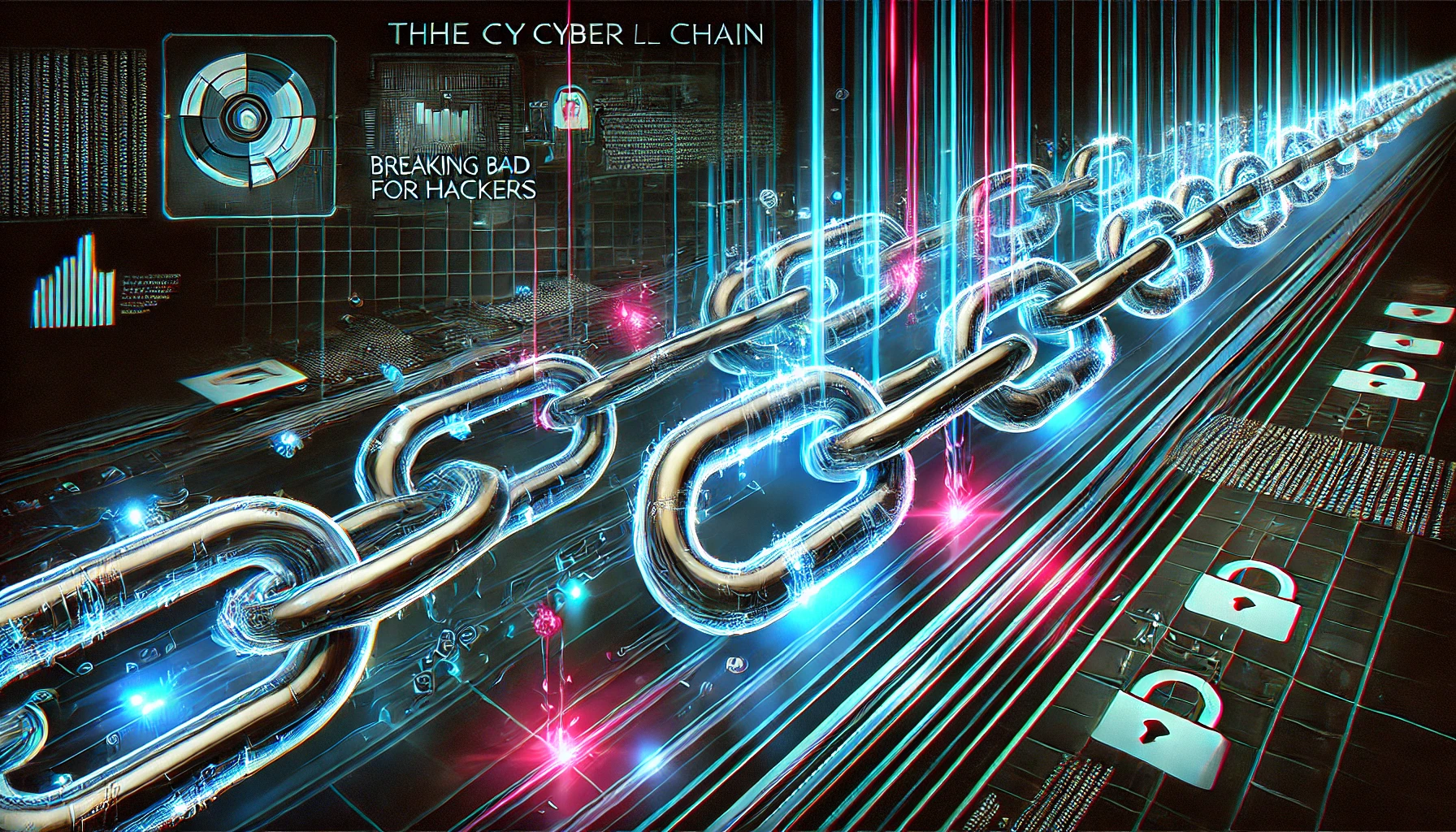
Analyzing the Cyber Kill Chain framework—because it’s better to be Walter White than Gus Fring in cyber defense.
In the world of cybersecurity, there’s a constant battle to outsmart hackers. It’s not unlike the plot of Breaking Bad—the struggle between Walter White, the calculated genius who always stays one step ahead, and Gus Fring, the kingpin whose overconfidence eventually leads to his downfall. The key to staying ahead in cybersecurity is understanding how hackers operate and how to disrupt their plans before they succeed. That’s where the Cyber Kill Chain (CKC) comes into play.
The Cyber Kill Chain framework breaks down cyberattacks into distinct phases. By analyzing these stages, organizations can develop a proactive defense strategy that catches hackers in their tracks. In this blog, we’ll dive deeply into the CKC, exploring how each phase can be countered with smart cybersecurity measures, much like Walter White’s brilliant strategies to outsmart his enemies.
What is the Cyber Kill Chain?
The Cyber Kill Chain is a model developed by Lockheed Martin to understand and disrupt the stages of a cyberattack. Much like any well-orchestrated heist or crime, cyberattacks follow a sequence of steps. By understanding these steps, cybersecurity teams can prevent or mitigate the damage before it escalates.
The CKC provides a structured way to look at an attack, break it down, and find weak points where defensive measures can be applied. Hackers don’t simply barge in and steal data—they follow a methodical process. The key to cyber defense is breaking that chain and stopping the attack before it reaches its final stage.
The Cyber Kill Chain consists of seven phases:
- Reconnaissance
- Weaponization
- Delivery
- Exploitation
- Installation
- Command and Control (C2)
- Actions on Objectives
Each phase of the Kill Chain offers an opportunity to stop the attack before it reaches its conclusion. Let’s break down each phase and how it can be countered.
Stage 1: Reconnaissance—Scoping the Territory
This phase, known as reconnaissance, is all about research. Hackers scan for vulnerabilities and gather data about employees, network configurations, and security protocols.
What Hackers Do:
- Use tools like open-source intelligence (OSINT) to find information about the target.
- Look for weak points in systems, employees (through social engineering), and networks.
How to Defend: At this stage, cybersecurity teams need to think like hackers. Proactive monitoring of external-facing systems can help detect early reconnaissance attempts. Implementing threat intelligence services that track suspicious activity is also critical. Additionally, educating employees about phishing and social engineering can minimize exposure.
Stage 2: Weaponization—The Right Tool for the Job
Once hackers have gathered enough information, it’s time for them to prepare their attack. In this phase, they create the malware or exploit that will be used to breach the system. Think of it as Walter White crafting the perfect batch of blue meth—hackers are building something that’s custom-designed to break into your defenses.
What Hackers Do:
- Develop malicious software (malware) designed to exploit the vulnerabilities identified in the reconnaissance phase.
- Combine malware with an exploit, creating a payload ready for delivery.
How to Defend: This is where strong vulnerability management comes into play. Regularly patching software and keeping systems up to date can minimize the chances that hackers will find an exploitable weakness. Conducting regular vulnerability scans and penetration tests can also help identify potential points of entry before hackers do.
Stage 3: Delivery—Setting the Trap
In this phase, the hacker delivers the payload—whether it’s through a phishing email, a malicious attachment, or even an infected USB drive. Hackers aim to sneak their malware into your system without drawing attention.
What Hackers Do:
- Use phishing attacks, malicious websites, or physical devices like USB drives to deliver their exploit.
- Target the weakest link—often human error, like an employee clicking on a suspicious email.
How to Defend: A combination of technical and human defenses is crucial here. Email and web filtering systems can catch malicious content before it reaches employees, while employee education can ensure that people recognize phishing attempts and know not to open suspicious emails or attachments.
Stage 4: Exploitation—Springing into Action
Once the payload has been delivered, the hacker’s next step is to exploit the vulnerability they’ve found. This is the phase where the attack moves from preparation to execution. Just like Walter White seizing the perfect moment to act, hackers execute their plan when the defenses are down.
What Hackers Do:
- Use the malware to exploit a vulnerability and gain access to the target system.
- Execute code that allows them to move further into the network.
How to Defend: At this stage, endpoint detection and response (EDR) systems and intrusion prevention systems (IPS) can help detect and stop the exploit before it takes hold. Keeping software patched and systems up to date is critical, as is ensuring that users have the least amount of privilege needed to do their jobs—this limits the damage if an exploit does succeed.
Stage 5: Installation—Establishing a Stronghold
Hackers now want to ensure they have long-term access to the system. In this stage, they install additional malware or create backdoors to allow them to return later, even if the initial exploit is discovered. Walter White always ensured he had a backup plan in case things went wrong—hackers do the same by setting up persistent access points.
What Hackers Do:
- Install additional malware such as rootkits, Trojans, or keyloggers.
- Establish persistence, ensuring they can maintain access even if some defenses are activated.
How to Defend: Application whitelisting and monitoring for unauthorized software installation can prevent hackers from gaining a foothold. Anti-malware solutions should be in place and updated regularly to detect and block malicious installations.
Stage 6: Command and Control (C2)—Pulling the Strings
Once hackers have access to your system, they need a way to control it remotely. This is where the command and control (C2) phase comes in. Hackers establish communication with compromised systems to issue commands and orchestrate further attacks.
What Hackers Do:
- Set up a command and control channel to communicate with the compromised systems.
- Direct further actions, such as moving laterally across the network or exfiltrating data.
How to Defend: Network segmentation and monitoring can detect and block unauthorized outbound traffic. Firewalls and intrusion detection systems (IDS) should be configured to block suspicious C2 traffic, and suspicious behavior patterns should trigger an alert for further investigation.
Stage 7: Actions on Objectives—Completing the Heist
This is the endgame for hackers—the moment they’ve been working toward. Whether they aim to steal sensitive data, deploy ransomware, or cause destruction, this is where the damage is done. In Breaking Bad, this is the moment Walter White’s plans come to fruition. For hackers, it’s payday.
What Hackers Do:
- Exfiltrate sensitive data, encrypt files for ransom, or disrupt systems to cause chaos.
- Achieve their ultimate goal—whether that’s financial gain, espionage, or destruction.
How to Defend: Data loss prevention (DLP) systems, real-time monitoring, and strong encryption can help protect sensitive data from being stolen. An incident response plan is critical to mitigating damage and recovering quickly when a breach occurs.
How to Stay Ahead of Hackers
In Breaking Bad, Walter White’s success depended on staying one step ahead of his rivals. The same principle applies to the Cyber Kill Chain. The goal is to break the kill chain at any point, stopping the hacker’s progress before they achieve their objective.
How to Defend:
- Proactive monitoring: Continuous network monitoring and threat intelligence can identify suspicious activity early in the kill chain.
- Defense in depth: Implementing multiple layers of security (e.g., firewalls, intrusion detection, endpoint protection) ensures that if one layer fails, others can pick up the slack.
- Incident response: Having a robust incident response plan ensures that even if a breach occurs, the damage can be contained and mitigated quickly.
To conclude, the Cyber Kill Chain is a valuable tool for understanding and defending against cyberattacks. By breaking down the attack into distinct stages, cybersecurity teams can anticipate the hacker’s next move and disrupt their plans before it’s too late.
By implementing the Cyber Kill Chain framework, you can turn the tables on hackers, stopping them and ensuring you’re always one step ahead in the cyber defense game.
Security, AI Risk Management, and Compliance with Akitra!
In the competitive landscape of SaaS businesses, trust is paramount amidst data breaches and privacy concerns. Akitra addresses this need with its leading AI-powered Compliance Automation platform. Our platform empowers customers to prevent sensitive data disclosure and mitigate risks, meeting the expectations of customers and partners in the rapidly evolving landscape of data security and compliance. Through automated evidence collection and continuous monitoring, paired with customizable policies, Akitra ensures organizations are compliance-ready for various frameworks such as SOC 1, SOC 2, HIPAA, GDPR, PCI DSS, ISO 27001, ISO 27701, ISO 27017, ISO 27018, ISO 9001, ISO 13485, ISO 42001, NIST 800-53, NIST 800-171, NIST AI RMF, FedRAMP, CCPA, CMMC, SOX ITGC, and more such as CIS AWS Foundations Benchmark, Australian ISM and Essential Eight etc. In addition, companies can use Akitra’s Risk Management product for overall risk management using quantitative methodologies such as Factorial Analysis of Information Risks (FAIR) and qualitative methods, including NIST-based for your company, Vulnerability Assessment and Pen Testing services, Third Party Vendor Risk Management, Trust Center, and AI-based Automated Questionnaire Response product to streamline and expedite security questionnaire response processes, delivering huge cost savings. Our compliance and security experts provide customized guidance to navigate the end-to-end compliance process confidently. Last but not least, we have also developed a resource hub called Akitra Academy, which offers easy-to-learn short video courses on security, compliance, and related topics of immense significance for today’s fast-growing companies.
Our solution offers substantial time and cost savings, including discounted audit fees, enabling fast and cost-effective compliance certification. Customers achieve continuous compliance as they grow, becoming certified under multiple frameworks through a single automation platform.
Build customer trust. Choose Akitra TODAY! To book your FREE DEMO, contact us right here.