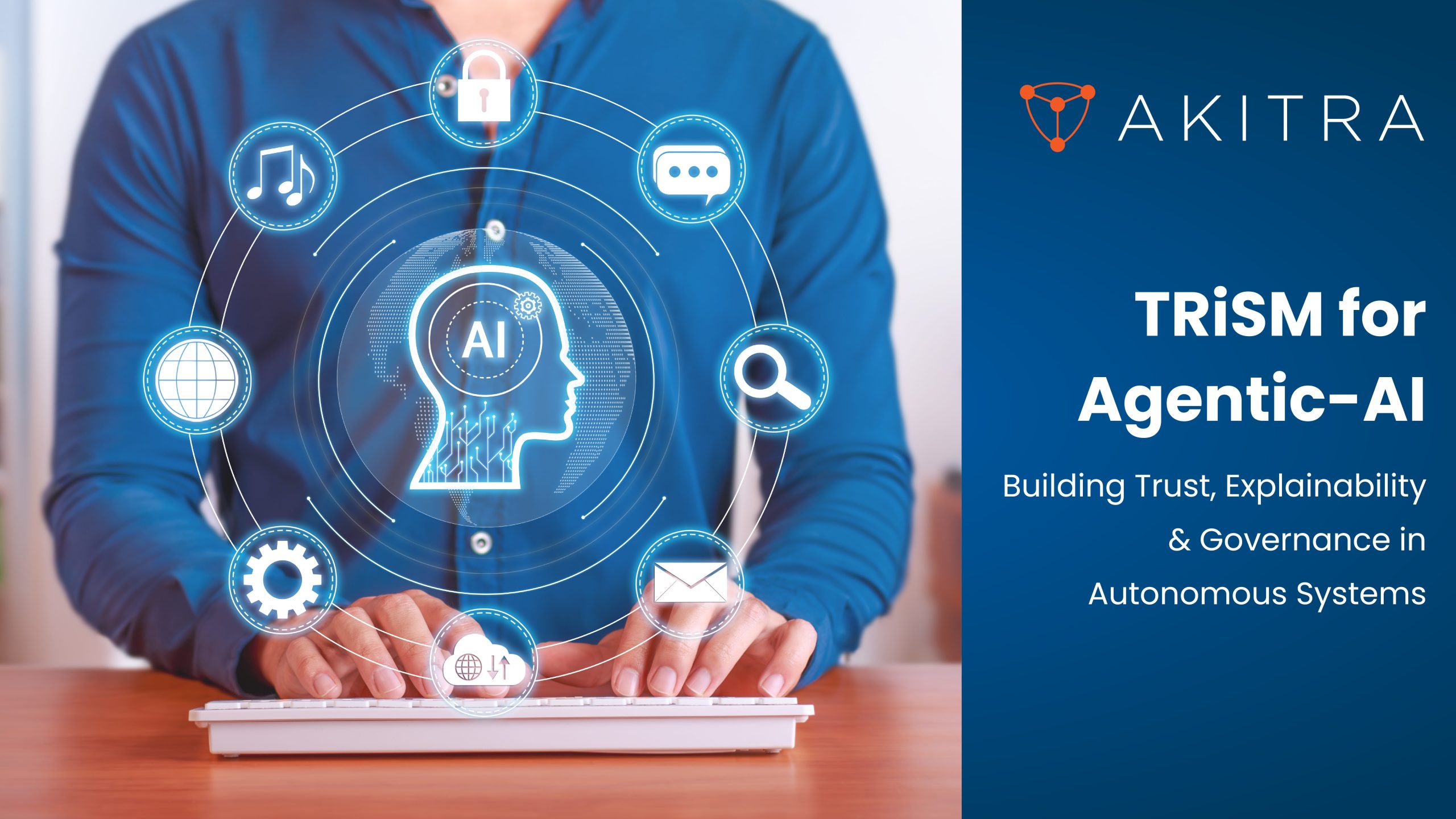
In today’s rapidly evolving AI landscape, agentic AI, artificial intelligence systems capable of making autonomous decisions and executing actions has emerged as a key focus. But with increasing autonomy comes increased responsibility. Stakeholders demand that these systems be trustworthy, understandable, and governed well. That’s where TRiSM; Trust, Risk, and Security Management, enters as a guiding framework.
In this blog, we’ll dive into how TRiSM principles can be applied to agentic AI to ensure robust trust, clear explainability, and effective governance. We’ll cover what agentic AI is, why TRiSM matters, practical strategies, and real-world considerations.
What Is Agentic AI?
Agentic AI refers to systems that can operate with varying degrees of autonomy, perceiving their environment, making decisions, and taking actions toward their goals. Unlike narrow AI systems that only provide predictions or classifications, agentic systems act in the world. Examples include autonomous drones, robotic process automation that negotiates tasks, or smart agents that interact with users to fulfil needs.
Because these systems act on their own, they bring new challenges:
- Unanticipated behaviors
- Accountability gaps
- Legal and ethical risks
- Complex feedback loops with the environment
Hence, designing agentic AI responsibly is much more demanding than building narrow prediction models.
Why TRiSM Matters in Agentic AI
TRiSM is a holistic approach that encompasses Trust, Risk, and Security Management. In the context of AI systems, it ensures that agents not only perform well but also behave safely, transparently, and in line with human values.
Here’s why each component is crucial:
- Trust
Users and stakeholders must believe the agentic AI’s decisions and actions will be aligned, fair, and reliable. Without trust, adoption stalls, oversight increases, and liability concerns magnify.
- Risk
Autonomous systems carry risks, including safety, privacy, misuse, unintended consequences, and adversarial attacks. A TRiSM view forces you to proactively identify, assess, and mitigate those risks.
- Security Management
Agentic AI must defend against malicious inputs, adversarial attacks, insider threats, and tampering. Security is the guardrail that ensures behavior stays within bounds.
Taken together, TRiSM provides a foundation for designing systems that people can trust, are explainable, and operate under governance.
Key Pillars: Trust, Explainability & Governance
Let’s break down how to build those three critical pillars using TRiSM for agentic AI.
1. Trust: Building Confidence in Autonomous Agents
To instill trust, focus on:
- Performance & Robustness
Ensure the system is reliable across different conditions, robust to input variation, partial failures, or noisy sensors.
- Consistency & Alignment
The agent’s goals, utility functions, and constraints must remain stable, interpretable, and aligned with human values. Avoid shifting hidden objectives that could surprise users.
- Validation & Verification
Rigorous testing, such as simulation, red teaming, and scenario-based evaluation, must validate behavior under extreme conditions.
- Fallback Mechanisms
Graceful degradation or human override capabilities help build confidence, as the system can request human intervention if it fails or is uncertain.
- Transparency
Users should gain clear, meaningful insights into how and why the agent made certain decisions (more on explainability to follow).
2. Explainability: From Black Box to Glass Box
Explainability is the bridge between trust and comprehension. For agentic AI, you need approaches tailored to systems that act—not just predict.
- Causal Models & Decision Traces
Maintain logs of decision steps, intermediate states, and causal links. When asked, “Why did you do X?”, you can replay the reasoning chain.
- Hierarchical Explanations
Offer multilevel explanations: a high-level summary for general users, and detailed technical traces for auditors or domain experts.
- Counterfactual Reasoning
Show “what-if” scenarios: “If input A had been different, the agent would have acted differently by doing B.” Helps users understand boundaries.
- Rule or Symbolic Overlays
In addition to learned policies, impose rule-based constraints or symbolic logic that can be directly inspected.
- User-centric Explanations
Tailor explanations to the user’s role: a clinician trusts different details than a developer or compliance officer.
3. Governance: Oversight, Auditing & Regulation
Governance ensures accountability, compliance, and ongoing alignment.
- Policy & Standards
Adopt clear policies or frameworks (e.g., AI ethics guidelines, regulatory mandates). Define acceptable action boundaries, safety constraints, and fairness criteria.
- Audit Trails & Logging
Immutable logs of decisions, state transitions, environment inputs and outputs. These act as “forensic records” later.
- Certification & Third-Party Review
Use external auditors to inspect models, security, and compliance. Provide stakeholders with certifications to build trust.
- Lifecycle Monitoring
Governance is not a one-time act. Continually monitor for drift, biased behavior, performance degradation, or emergent failures.
- Redress & Recourse Mechanisms
Mechanisms for users or regulators to challenge or correct wrongful behavior, e.g., appeal, rollback, human override, accountability channels.
Applying TRiSM in Practice: A Roadmap
Here’s a step-by-step roadmap to apply TRiSM when developing agentic AI:
- Define Scope & Stakeholders
Clarify the domain (e.g., autonomous driving, financial trading agent), potential risks, and identify your key stakeholders (users, regulators, auditors).
- Model Safety & Risk Assessment
Conduct a hazard analysis, threat modeling, and failure modes and effects analysis (FMEA) for the autonomous behaviors.
- Design with Explainability in Mind
Choose architectures or hybrid models that facilitate interpretability (e.g. modular planning + learned policy). Decide how explanations will be surfaced.
- Build Trust Mechanisms
Include fallback strategies, consistency checks, anomaly detectors, and confidence thresholds.
- Implement Security Controls
Harden model assets, input validation, adversarial defenses, access controls, and integrity checks.
- Instrumentation & Logging
Embed instrumentation to track state transitions, decisions, context, environmental sensors, and human overrides.
- Testing & Red-Teaming
Stress-test in simulation and real environments, conduct adversarial tests, edge-case scenarios, and “mischievous agent” tests.
- Governance & Audit Frameworks
Establish oversight bodies, implement audit policies, and establish review cycles. Integrate governance from design through deployment.
- Monitoring & Feedback Loops
Continuously monitor metrics, detect drift or anomaly, collect user feedback, trigger retraining or interventions as needed.
- Incident Response & Remediation
Prepare protocols for failure, rollback, human intervention, and post-mortems.
Challenges & Trade-offs
No framework is perfect, TRiSM in agentic AI must navigate complexity and trade-offs:
- Performance vs. Transparency
Highly optimized black-box models (e.g., deep reinforcement learning) may resist interpretability. You may need hybrid models or approximations.
- Explainability Overhead
Recording detailed logs and causal chains consumes storage and processing resources; real-time systems may struggle under this overhead.
- Governance Burden
Too heavy-handed governance can stifle innovation or cause delays. It’s essential to strike a balance between oversight and agility.
- Ambiguous Liability
As agents act autonomously, legal and moral liability becomes murky. Who is accountable, the developer, deployer, user, or the system itself?
- Evolving Environments
Autonomous agents operate in unpredictable real-world settings. New scenarios may surface risks for which no training data has been captured.
Understanding these trade-offs and designing effective mitigation strategies is crucial for the successful deployment of these technologies in the real world.
Key Takeaways & Best Practices
- Embed TRiSM from Day One: Don’t treat trust, security, and governance as add-ons. They must be integrated from the design phase.
- Hybrid Models Help: Use architectures that balance learning-based autonomy with symbolic or rule-based layers for transparency.
- Tailor Explanations to the Audience: Always remember that different stakeholders (users, developers, and regulators) require varying levels of explanation.
- Test the Unexpected: Simulate rare edge cases, adversarial inputs, and emergent behaviors.
- Foster Human-in-the-Loop: Even highly autonomous systems should allow oversight, fallback, and intervention.
- Keep Governance Lean but Effective: The oversight processes should be real, practical, and responsive—not burdensome red tape.
- Monitor Continuously: Watch for drift, bias, anomalies, or shifts in the environment that violate assumptions.
Conclusion
As agentic AI systems become more prevalent—from autonomous vehicles to smart assistants, they’ll be challenged to perform not just well, but responsibly. TRiSM; Trust, Risk, and Security Management, offers a comprehensive lens to ensure these systems are trustworthy, explainable, and governed. By embedding trust mechanisms, designing explainable architectures, and providing rigorous oversight, we can enable agentic systems that users and society can confidently adopt.
In the march toward intelligent autonomy, let TRiSM be your compass, a balanced guide to creating systems that not only act but also act ethically, transparently, and with accountability.
Security, AI Risk Management, and Compliance with Akitra!
In the competitive landscape of SaaS businesses, trust is paramount amidst data breaches and privacy concerns. Akitra addresses this need with its leading Agentic AI-powered Compliance Automation platform. Our platform empowers customers to prevent sensitive data disclosure and mitigate risks, meeting the expectations of customers and partners in the rapidly evolving landscape of data security and compliance. Through automated evidence collection and continuous monitoring, paired with customizable policies, Akitra ensures organizations are compliance-ready for various frameworks such as SOC 1, SOC 2, HIPAA, GDPR, PCI DSS, ISO 27001, ISO 27701, ISO 27017, ISO 27018, ISO 9001, ISO 13485, ISO 42001, NIST 800-53, NIST 800-171, NIST AI RMF, FedRAMP, CCPA, CMMC, SOX ITGC, and more such as CIS AWS Foundations Benchmark, Australian ISM and Essential Eight etc. In addition, companies can use Akitra’s Risk Management product for overall risk management using quantitative methodologies such as Factorial Analysis of Information Risks (FAIR) and qualitative methods, including NIST-based for your company, Vulnerability Assessment and Pen Testing services, Third Party Vendor Risk Management, Trust Center, and AI-based Automated Questionnaire Response product to streamline and expedite security questionnaire response processes, delivering huge cost savings. Our compliance and security experts provide customized guidance to navigate the end-to-end compliance process confidently. Last but not least, we have also developed a resource hub called Akitra Academy, which offers easy-to-learn short video courses on security, compliance, and related topics of immense significance for today’s fast-growing companies.
Our solution offers substantial time and cost savings, including discounted audit fees, enabling fast and cost-effective compliance certification. Customers achieve continuous compliance as they grow, becoming certified under multiple frameworks through a single automation platform.
Build customer trust. Choose Akitra TODAY!To book your FREE DEMO, contact us right here.
FAQ’S
Why is TRiSM important specifically for agentic AI?
Because autonomous agents can cause real-world actions and impacts, TRiSM ensures we address not only accuracy, but also trustworthiness, risks of misbehavior, security threats, and accountability—things conventional models don’t face as intensely.
How can we provide explainability in autonomous systems without compromising performance?
Use hybrid approaches: symbolic overlays, causal traces, hierarchical explanations, and counterfactual reasoning. You can record and summarize decisions smartly so that the real-time system isn’t bogged down, while explanations are provided on demand.
What role does governance play after deployment?
Governance ensures ongoing oversight, compliance, auditability, drift detection, recourse mechanisms, stakeholder accountability, and adaptation to changing environments or regulations.
How do you balance innovation with regulatory constraints in building agentic AI?
Start with minimal but robust governance and iterate. Engage with stakeholders and regulators early. Design modular systems that allow constraints to evolve and adapt. Utilize simulation and sandbox environments to innovate safely before full deployment.