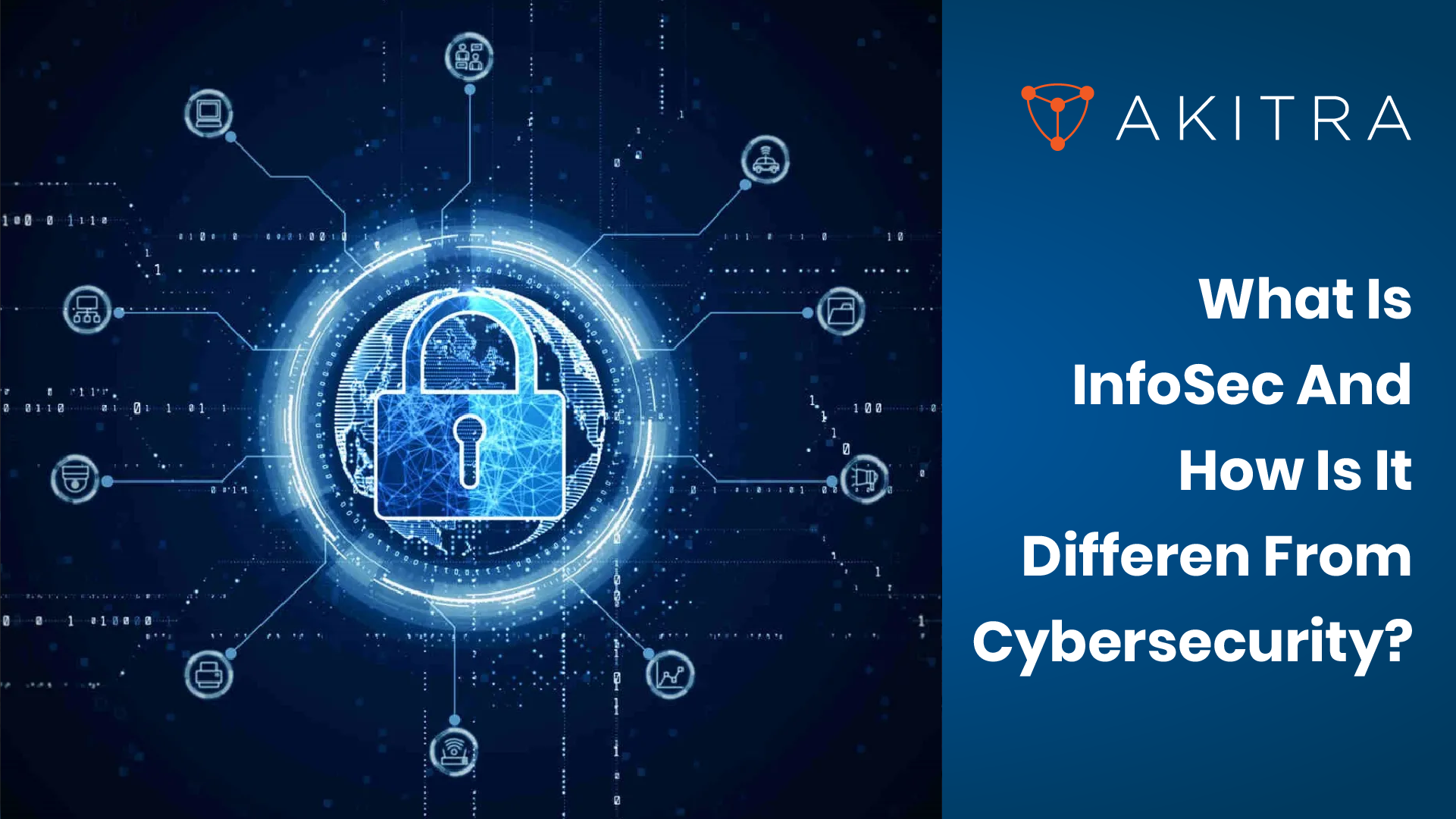
In our always-online world, the terms information security (InfoSec) and cybersecurity often get thrown around like they mean the same thing. And to be fair, they’re closely related—but not interchangeable.
Understanding the difference isn’t just a matter of technical nitpicking. It has real-world implications for how organizations protect sensitive data, stay compliant with regulations, and respond to emerging threats. Whether you’re a business owner, IT lead, or compliance officer, knowing where InfoSec ends and cybersecurity begins can help you build a smarter, more complete defense strategy.
In this post, we’ll unpack what InfoSec really involves, how it connects to cybersecurity, and why both disciplines are essential—not optional—for modern risk management.
What Is InfoSec?
Information Security, or InfoSec for short, is all about protecting information—in any form—from unauthorized access, tampering, or destruction.
That means digital stuff like databases and emails, sure. But also physical documents, ID cards, intellectual property, and even what employees know in their heads. If it holds value or contains sensitive data, it falls under the InfoSec umbrella.
InfoSec strategies typically cover:
- Digital assets like files, databases, and apps
- Physical documents such as contracts or printed reports
- Intellectual property including patents and trade secrets
- People-related risks like employee access and insider threats
It’s a holistic approach to protecting what matters—no matter where or how it exists.
The CIA Triad: InfoSec’s Guiding Principles
At the heart of InfoSec is a framework known as the CIA Triad:
- Confidentiality – Making sure information is only accessible to those with the proper clearance.
Example: Encrypting customer credit card data. - Integrity – Ensuring data hasn’t been altered without authorization.
Example: Verifying file integrity using hash checks. - Availability – Keeping systems and information accessible when needed.
Example: Using redundant servers or disaster recovery plans.
Though modern InfoSec often expands into things like accountability and non-repudiation, the CIA model remains the foundation.
What Is Cybersecurity?
Cybersecurity narrows its focus to digital threats—the hackers, malware, phishing scams, and ransomware attacks that target online systems and networks.
It’s the arm of InfoSec that defends the digital frontier. If it lives on a network, connects to the cloud, or stores data online, cybersecurity has a hand in protecting it.
Core areas of cybersecurity include:
- Network security – Firewalls, intrusion detection, VPNs
- Application security – Code audits, input validation, patching
- Endpoint security – Antivirus tools, MDM software
- Cloud security – Zero trust, secure APIs, access controls
- Incident response – Identifying and responding to breaches quickly
If InfoSec is the whole security house, cybersecurity is the high-tech alarm system guarding your digital doors and windows.
InfoSec vs Cybersecurity: What’s the Difference?
Here’s how the two stack up:
|
Aspect |
InfoSec |
Cybersecurity |
|
Scope |
All information, in any form |
Digital systems and data only |
|
Focus |
Protecting confidentiality, integrity, and availability |
Preventing/responding to cyber threats |
|
Medium |
Physical + digital |
Digital only |
|
Examples |
Access controls, document handling policies |
Firewalls, MFA, endpoint protection |
|
Regulations |
ISO 27001, GDPR, HIPAA |
NIST CSF, PCI DSS, SOC 2 |
|
Common Threats |
Insider leaks, lost documents |
Hackers, malware, ransomware |
Think of InfoSec as the big-picture strategy, and cybersecurity as one (very important) piece of that puzzle.
Where the Two Overlap
Despite their differences, InfoSec and cybersecurity often work hand-in-hand. In many cases, the lines blur.
Take this scenario:
An employee leaves a stack of sensitive documents at a coffee shop (InfoSec issue). Someone finds them, scans them, and posts them online (cybersecurity breach).
Both fields matter. And both need to coordinate to close the loop on vulnerabilities.
Shared priorities include:
- Data protection
- Risk assessments
- Employee training
- Compliance alignment
- Incident response
Examples of InfoSec in the Real World
- Biometric access controls to restrict entry to data centers
- Document labeling (e.g., “confidential,” “internal only”)
- Shredding policies for disposing of sensitive paperwork
- Security training to educate staff on phishing and insider threats
- Legal protections like NDAs and IP clauses in contracts
Examples of Cybersecurity in the Real World
- Firewalls and intrusion detection systems blocking suspicious traffic
- Multi-factor authentication (MFA) for cloud applications
- TLS encryption securing web and email communications
- Penetration testing to uncover system vulnerabilities
- Endpoint monitoring with EDR tools to catch malware early
Why Businesses Need Both
Here’s the truth: leaning on just one of these is like locking your front door but leaving the windows wide open.
You need both InfoSec and cybersecurity to:
- Protect your data end-to-end – from printed documents to cloud backups
- Comply with overlapping regulations
- Safeguard your reputation
- Avoid costly breaches that can take months—and millions—to fix
It’s not just about defense. It’s about building resilience and trust.
Compliance Standards: InfoSec vs Cybersecurity
InfoSec-Focused Frameworks:
- ISO/IEC 27001 – A global standard for information security management
- HIPAA – Protects patient health information
- GDPR – Sets rules for handling personal data of EU residents
Cybersecurity-Focused Frameworks:
- NIST CSF – Widely used in the U.S. for critical infrastructure
- PCI DSS – Covers secure processing of cardholder data
- SOC 2 – Evaluates cloud provider controls and practices
Most organizations need to comply with standards from both sides.
What’s Next? Trends Reshaping Both Fields
- Zero Trust Models – No more implicit trust, even within your own network
- AI/ML in Security – For smarter threat detection and faster response
- Cloud-First Security – Especially for hybrid and multi-cloud environments
- New Regulations – From India’s DPDPA to the EU AI Act
- Quantum Readiness – Preparing for cryptography’s next big challenge
Security strategies need to evolve in lockstep with these trends—or risk falling behind.
Building a Unified Security Strategy
To truly future-proof your organization:
- Start with a risk assessment – Identify both physical and digital weak spots
- Use automation – Especially for audit prep, monitoring, and compliance
- Layer your defenses – Combine physical security, software controls, and user training
- Train your people – They’re often your weakest (or strongest) link
- Monitor everything – And respond quickly when something’s off
Integrated security is stronger security.
Final Thoughts
At a glance, InfoSec and cybersecurity may seem like two sides of the same coin—and in some ways, they are. But knowing the difference matters. A lot.
- InfoSec is the broader discipline that safeguards all forms of information.
- Cybersecurity is laser-focused on defending against digital threats.
Together, they form the backbone of modern risk management. Companies that embrace both aren’t just more secure—they’re more trusted, more compliant, and ultimately, more competitive.
Security, AI Risk Management, and Compliance with Akitra!
In the competitive landscape of SaaS businesses, trust is paramount amidst data breaches and privacy concerns. Akitra addresses this need with its leading AI-powered Compliance Automation platform. Our platform empowers customers to prevent sensitive data disclosure and mitigate risks, meeting the expectations of customers and partners in the rapidly evolving landscape of data security and compliance. Through automated evidence collection and continuous monitoring, paired with customizable policies, Akitra ensures organizations are compliance-ready for various frameworks such as SOC 1, SOC 2, HIPAA, GDPR, PCI DSS, ISO 27001, ISO 27701, ISO 27017, ISO 27018, ISO 9001, ISO 13485, ISO 42001, NIST 800-53, NIST 800-171, NIST AI RMF, FedRAMP, CCPA, CMMC, SOX ITGC, and more such as CIS AWS Foundations Benchmark, Australian ISM and Essential Eight etc. In addition, companies can use Akitra’s Risk Management product for overall risk management using quantitative methodologies such as Factorial Analysis of Information Risks (FAIR) and qualitative methods, including NIST-based for your company, Vulnerability Assessment and Pen Testing services, Third Party Vendor Risk Management, Trust Center, and AI-based Automated Questionnaire Response product to streamline and expedite security questionnaire response processes, delivering huge cost savings. Our compliance and security experts provide customized guidance to navigate the end-to-end compliance process confidently. Last but not least, we have also developed a resource hub called Akitra Academy, which offers easy-to-learn short video courses on security, compliance, and related topics of immense significance for today’s fast-growing companies.
Our solution offers substantial time and cost savings, including discounted audit fees, enabling fast and cost-effective compliance certification. Customers achieve continuous compliance as they grow, becoming certified under multiple frameworks through a single automation platform.
Build customer trust. Choose Akitra TODAY! To book your FREE DEMO, contact us right here.
FAQ’s
Which came first—InfoSec or cybersecurity?
InfoSec. Cybersecurity grew out of the need to protect digital information as technology evolved.
Do small businesses really need both?
Absolutely. Even a small business handles sensitive data—payroll records, customer info, online transactions. That’s all in scope.
Absolutely. Even a small business handles sensitive data—payroll records, customer info, online transactions. That’s all in scope.
InfoSec is usually led by a Chief Information Security Officer (CISO). Cybersecurity is often handled by SOC teams, network admins, or cybersecurity analysts.
What’s the biggest risk of ignoring InfoSec?
Even without a hacker in sight, poor InfoSec can lead to insider leaks, regulatory fines, and major reputational damage.