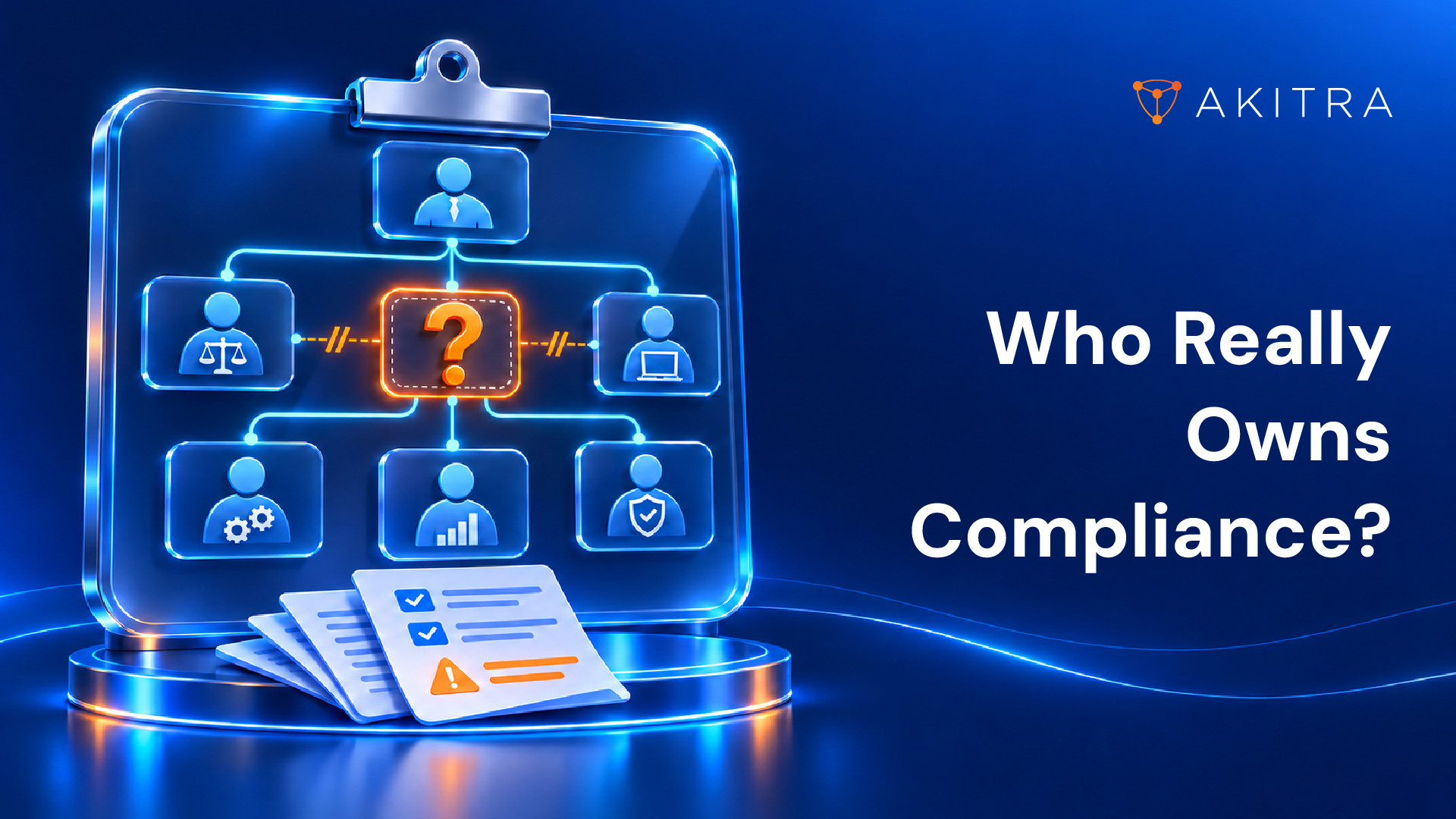
Who is responsible for compliance? Senior leadership is ultimately accountable, a designated compliance lead coordinates the program, and control owners in IT, security, engineering, legal, and HR do the day-to-day work. Ownership gets unclear when these layers blur. Every activity needs a named decision-maker, a named doer, and a clear escalation path.
Key Takeaways
- Compliance is shared across the business, but accountability is not: one named executive owns the outcome.
- A department name in a tracker is not an assignment. Ownership exists only when a specific person accepts a specific deliverable.
- Every cross-team decision needs one final decision-maker, or it stalls while teams wait on each other.
- Ownership decays as people, systems, and org charts change, so review assignments whenever they do.
The Three Layers of Compliance Responsibility
Accountability (executive level). A named executive, such as the CEO, COO, CTO, or CISO, owns the outcome, funds the program, and resolves escalations. The standards expect this. ISO/IEC 27001 (Clause 5.3) expects top management to assign and communicate roles, responsibilities, and authorities, and HIPAA requires designated privacy and security officials.
Coordination (compliance or GRC lead). One person runs the program day to day: tracking requirements, chasing owners, reporting status, and preparing for audits. The lead coordinates but does not own everyone else’s controls.
Operation (control owners). The people closest to the work run the controls, handle exceptions, and keep evidence.
|
Role |
Accountable for |
Typically performs |
|
Executive sponsor |
Program outcome, resources, escalations |
Approves risk acceptance; settles disputes |
|
Compliance lead |
Coordination and reporting |
Tracks requirements, status, and blockers |
|
Security |
Security policy and risk oversight |
Vulnerability management, incident response |
|
IT |
Identity, access, and endpoint controls |
Access reviews, provisioning |
|
Engineering |
Secure development and infrastructure |
Change management, logging, encryption |
|
Legal or privacy |
Regulatory and contractual obligations |
Reviews data-handling terms and vendor agreements |
|
HR |
People-related controls |
Onboarding, offboarding, training |
Illustrative allocation. Actual authority and liability depend on your organization, regulators, and contracts.
In a small company, one person may hold several roles. The caution: the person who performs a control should not be its only reviewer, because auditors look for separation between doing and checking.
Roles by Company Stage
Early-stage startups: A founder or CTO is accountable, one person coordinates part-time, and engineers and IT staff own the controls.
Growth-stage companies: A dedicated compliance or GRC lead usually exists, controls have formal owners with backups, and a small steering group resolves cross-team decisions.
Enterprises: The board or audit committee oversees the program, specialist roles such as a CISO or data protection officer lead their areas, business units own their controls, and internal audit provides independent assurance.
Who Is Not Responsible for Your Compliance
- Your auditor. Auditors assess controls independently, so they cannot design or run them.
- Your cloud provider. Under the shared responsibility model, providers secure the infrastructure while you remain responsible for configuration, access, and data.
- Your vendors and consultants. They can perform agreed activities, but outsourcing work does not outsource accountability.
Why Ownership Gets Unclear
Consider an illustrative SaaS team launching a customer-data export feature. Engineering expects legal to approve the data-handling terms. Legal expects security to coordinate. Nobody owns the final decision before launch. This is rarely carelessness. It usually follows predictable patterns.
Department Names Are Mistaken for Owners
A customer’s security questionnaire arrives, and the tracker assigns it to “Security.” That label names a function, not a person. Nobody has been asked to draft answers, review them, or meet a deadline, so the assignment was never accepted.
Cross-Team Decisions Have No Final Owner
Engineering explains the feature, security comments on safeguards, and legal raises questions about data-handling terms. Each team contributes, but nobody owns bringing those inputs to a decision. Contributing advice is not the same as coordinating completion.
Assigned Owners Cannot Approve or Escalate
The compliance lead coordinates the review but cannot settle a disagreement between security and engineering. Without an escalation route, the lead is responsible for progress yet has no access to someone who can unblock it.
Business Changes Erode Ownership
Even clear assignments decay. Four changes cause most of the damage:
- Rapid growth. Roles that worked when five people shared everything fail at fifty. Informal “everyone knows Sam handles that” ownership does not survive new hires and new teams.
- Reorganizations. When teams merge or split, controls often stay attached to a role that no longer exists, or to a manager who has moved on.
- Tool migrations. Recurring tasks, approvals, and reminders can vanish when a ticketing or workflow system is replaced, and the owner may never notice.
- Shared-responsibility confusion. Teams assume a cloud provider, vendor, or consultant covers a control that the company still owns. Each side believes the other is handling it.
Each change shifts who does the work without updating who is named as responsible. That gap is where controls quietly stop running.
A RACI Matrix for the Export Launch
A RACI matrix marks each task as Responsible (does the work), Accountable (owns the outcome), Consulted, or Informed. The rule that matters: every task has exactly one Accountable person.
|
Task |
Engineering |
Security |
Legal |
Compliance lead |
Executive |
|
Document data flow and safeguards |
A/R |
C |
C |
I |
I |
|
Review technical safeguards |
C |
A/R |
I |
I |
I |
|
Assess data-handling terms |
C |
C |
A/R |
I |
I |
|
Collect inputs and track open items |
C |
C |
C |
A/R |
I |
|
Decide go or no-go, record conditions |
C |
C |
C |
R |
A |
Each team now has a defined piece, the compliance lead collects inputs without deciding, and a designated executive makes the call, with unresolved conditions recorded alongside the decision.
How to Establish Clear Compliance Ownership
- Name executive oversight and a program lead. Identify who resolves escalations and who coordinates daily work.
- Assign operating owners, reviewers, and backups. Record each deliverable and confirm the owner has accepted it.
- Define decision authority and escalation. State who approves each outcome and where disagreements go.
- Review assignments after changes. Revisit ownership after growth, reorganizations, migrations, departures, or any launch or audit where a handoff stalled.
When to Hire a Dedicated Compliance Role
Most early-stage companies can start with a part-time coordinator and named control owners. A dedicated hire is worth considering when several of these are true:
- You are pursuing a second or third framework, such as SOC 2 plus ISO 27001 or HIPAA.
- Customer security reviews and questionnaires are slowing sales.
- Evidence collection consumes engineering or IT time every quarter.
- Controls are failing between audits because nobody is watching them.
Until then, a fractional compliance lead or virtual CISO can provide expertise while internal owners run the work. Either way, the accountable executive should be a named person inside the company.
How Akitra Helps Teams Keep Ownership Clear
Assigning ownership is a decision. Keeping it visible as the business changes is the harder part.
Akitra Andromeda® helps teams manage the follow-through:
- Track assignments and approvals: see who owns each task and which milestones are at risk.
- Collect supporting evidence: gather records from supported integrations for owner review.
- Monitor controls: surface gaps and overdue work so owners can follow up.
The platform supports coordination. Your team still establishes accountability, assigns authority, and makes the decisions.
Request an Akitra demo to see assignments, approvals, and evidence tracked in one place.
Your Next Step
Pick one compliance decision waiting on input from several teams. Confirm who coordinates it, who contributes, who decides, and where it goes if the teams disagree. If you cannot answer in a few minutes, you have found your next stalled launch, audit, or customer review.
Security, AI Risk Management, and Compliance with Akitra!
In the competitive landscape of SaaS businesses, trust is paramount amidst data breaches and privacy concerns. Akitra addresses this need with its leading Agentic AI-powered Compliance Automation platform. Our platform empowers customers to prevent sensitive data disclosure and mitigate risks, meeting the expectations of customers and partners in the rapidly evolving landscape of data security and compliance. Through automated evidence collection and continuous monitoring, paired with customizable policies, Akitra ensures organizations are compliance-ready for various frameworks such as SOC 1, SOC 2, HIPAA, GDPR, PCI DSS, ISO 27001, ISO 27701, ISO 27017, ISO 27018, ISO 9001, ISO 13485, ISO 42001, NIST 800-53, NIST 800-171, NIST AI RMF, FedRAMP, CCPA, CMMC, SOX ITGC, and more such as CIS AWS Foundations Benchmark, Australian ISM and Essential Eight etc. In addition, companies can use Akitra’s Risk Management product for overall risk management using quantitative methodologies such as Factorial Analysis of Information Risks (FAIR) and qualitative methods, including NIST-based for your company, Vulnerability Assessment and Pen Testing services, Third Party Vendor Risk Management, Trust Center, and AI-based Automated Questionnaire Response product to streamline and expedite security questionnaire response processes, delivering huge cost savings. Our compliance and security experts provide customized guidance to navigate the end-to-end compliance process confidently. Last but not least, we have also developed a resource hub called Akitra Academy, which offers easy-to-learn short video courses on security, compliance, and related topics of immense significance for today’s fast-growing companies.
Our solution offers substantial time and cost savings, including discounted audit fees, enabling fast and cost-effective compliance certification. Customers achieve continuous compliance as they grow, becoming certified under multiple frameworks through a single automation platform.
Build customer trust. Choose Akitra TODAY!To book your FREE DEMO, contact us right here.
Frequently Asked Questions
Is compliance the responsibility of IT or security?
No. IT and security own important controls, but compliance also depends on engineering, legal, HR, and leadership. Ownership follows the activity: IT runs access reviews, HR runs offboarding, legal reviews contracts, and an executive stays accountable overall.
Who should coordinate compliance in a small company?
A founder or designated lead can coordinate the program part-time, with named control owners performing the work. A dedicated or fractional role becomes worthwhile as frameworks, customer reviews, and evidence collection consume engineering or IT time.
How does a compliance lead differ from a control owner?
The compliance lead coordinates the program: tracking status, reporting, and chasing blockers. A control owner performs a specific activity, handles its exceptions, and keeps its evidence. The lead asks whether the work is done; the owner does it.
Can external providers take over compliance responsibilities?
Providers can perform agreed activities such as monitoring or advisory work. The responsibilities you retain depend on your agreement and the applicable requirements, and accountability generally stays inside your organization. Name an internal owner for every outsourced activity.