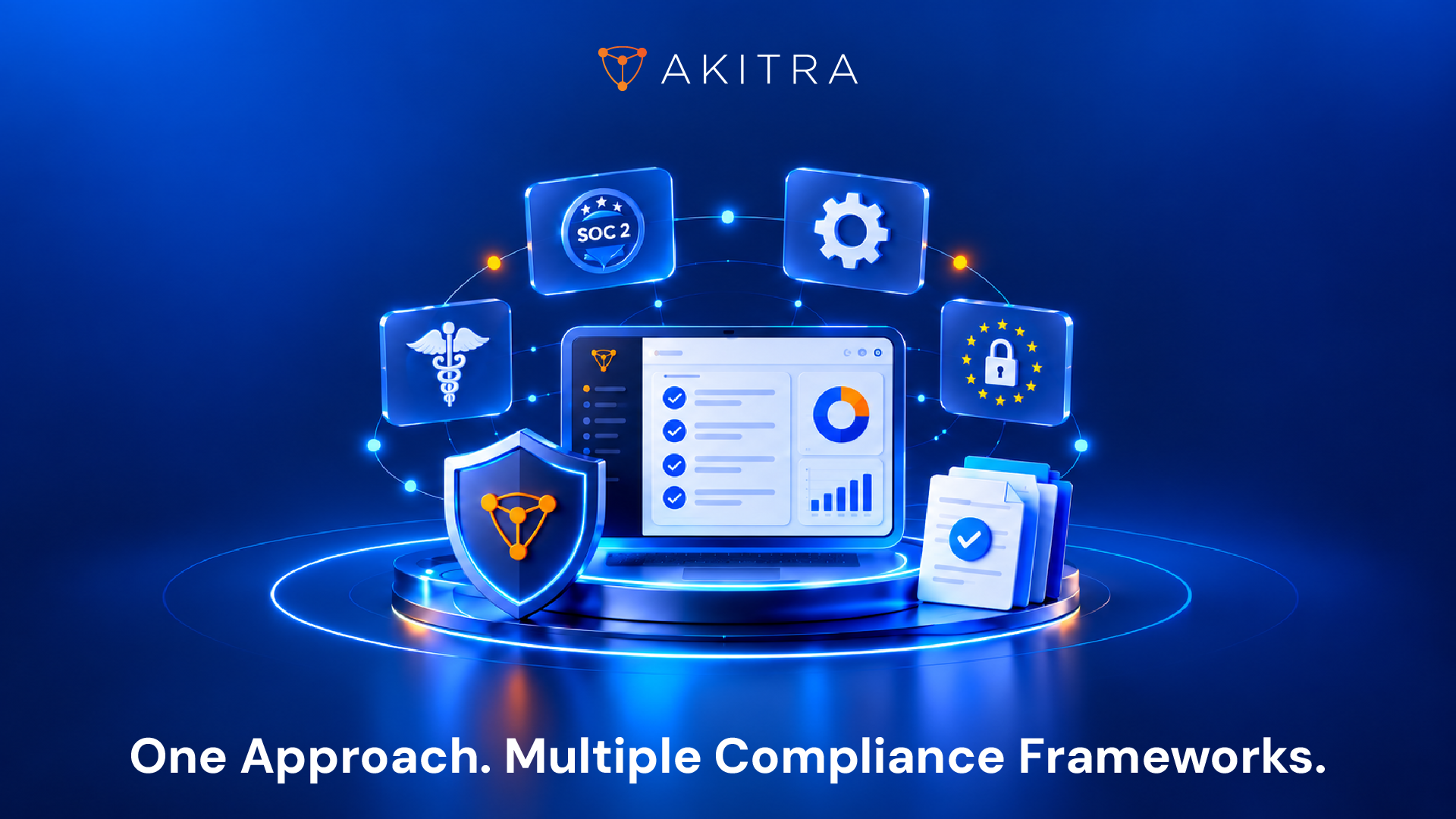
Managing multiple compliance frameworks starts with identifying shared controls, checking where evidence can be reused, and tracking requirements that need separate attention. SOC 2, ISO 27001, HIPAA, and GDPR have overlapping security concerns, but different scopes and obligations mean a report or assessment for one framework cannot establish compliance with the others.
Key Takeaways
- Find shared work: Map common activities to applicable requirements, and validate each mapping.
- Check before reusing: Confirm evidence scope, dates, and completeness.
- Keep obligations distinct: Shared controls do not cover every requirement.
- Coordinate ownership: Maintain clear owners and track framework-specific additions.
Why Managing Multiple Compliance Frameworks Feels Repetitive
The hypothetical SaaS team’s security lead exports an access review for SOC 2. Later, another owner requests similar records for ISO 27001, while privacy and healthcare compliance teams ask whether those reviews cover relevant personal data and electronic protected health information (ePHI).
Separate trackers turn related requests into separate projects. Owners repeat exports, rename files, and reconcile versions.
The requirements also serve different purposes. SOC 2 provides assurance about examined controls; ISO 27001 addresses an information security management system. HIPAA and GDPR impose applicable legal obligations. Managing them together requires understanding these differences alongside the shared work.
How Much Compliance Work Can You Reuse?
There is no universal overlap percentage. Reuse depends on applicable requirements, system boundaries, data, and the evidence needed to demonstrate each activity.
Security activities such as access management, risk assessment, and incident response often appear across several frameworks, so start there:
Explore Akitra’s SOC 2 Multi-Framework Crosswalk to identify reusable controls and framework-specific gaps across SOC 2, ISO 27001, HIPAA, GDPR, and more.
|
Shared activity |
Potentially reusable evidence |
Framework-specific checks |
|
Access management |
Access reviews and removal records |
Confirm SOC 2 and ISO 27001 scope coverage and which systems handle HIPAA ePHI or GDPR personal data. |
|
Risk assessment |
Inventories, data flows, and risk records |
Check coverage of HIPAA ePHI risks and GDPR risks to individuals’ rights and freedoms. |
|
Incident response |
Response procedures and exercise records |
Separately evaluate applicable HIPAA and GDPR breach-notification triggers, recipients, and deadlines. |
Illustrative overlap, not a complete requirement mapping. HIPAA and GDPR require separate analysis of their applicable risk and notification obligations.
Can One Control Satisfy Several Requirements?
Yes, a shared control can address requirements across several frameworks when its design, scope, and operation meet each requirement. Control mapping identifies those connections; teams must validate whether the control actually covers them.
For the hypothetical SaaS team, one access-review process might cover systems relevant to several compliance obligations. Its owner reviews access, records decisions, and follows up on removals. That process can support multiple mapped requirements without being performed separately for each framework.
Evidence reuse needs another check. A record may demonstrate that the review occurred, yet omit an application, user group, or date needed for another request.
Shared controls also leave additional obligations. An access review does not establish a lawful basis for processing under GDPR or fulfill applicable HIPAA breach-notification duties. Track those requirements separately.
How to Stop Collecting the Same Evidence Repeatedly
Use four steps to turn overlapping work into a coordinated process:
- Confirm applicability and scope. Identify relevant obligations, systems, data, and assessment dates. Record differences so a shared process does not hide coverage gaps.
- Build and validate control mappings. Link each internal control to the requirements it supports. Have security, privacy, and compliance owners check the rationale and flag requirements needing additional procedures.
- Assign owners and maintain source evidence. Give each control an operating owner. Link requests to maintained records, checking dates, completeness, and coverage before reuse. Preserve versions and restrict access to sensitive evidence.
- Track additions and review changes. Keep framework-specific tasks visible alongside shared controls. Revisit mappings when services, vendors, data flows, or requirements change. Treat a mapped requirement as unresolved until its implementation and supporting evidence have been reviewed.
The team can then answer matching access-review requests from one maintained record, while collecting additional evidence where coverage differs.
How Akitra Helps Coordinate Multiple Frameworks
Akitra Andromeda® helps teams manage multi-framework compliance by coordinating shared controls and supporting records:
- Map controls and reuse evidence: Connect common requirements and reuse relevant evidence across frameworks, with teams validating coverage.
- Automate compliance evidence collection: Gather records from supported integrations to reduce repeated manual requests.
- Monitor controls and outstanding work: Identify gaps and track tasks requiring follow-up.
Teams remain responsible for confirming applicability, reviewing evidence, and addressing framework-specific obligations.
Request an Akitra demo to explore a coordinated approach to compliance.
Conclusion
Start with one repeatedly requested record. Identify which requirements it supports, validate its coverage, and assign ownership. Managing multiple compliance frameworks becomes more practical when each reuse decision has a clear basis.
Security, AI Risk Management, and Compliance with Akitra!
In the competitive landscape of SaaS businesses, trust is paramount amidst data breaches and privacy concerns. Akitra addresses this need with its leading Agentic AI-powered Compliance Automation platform. Our platform empowers customers to prevent sensitive data disclosure and mitigate risks, meeting the expectations of customers and partners in the rapidly evolving landscape of data security and compliance. Through automated evidence collection and continuous monitoring, paired with customizable policies, Akitra ensures organizations are compliance-ready for various frameworks such as SOC 1, SOC 2, HIPAA, GDPR, PCI DSS, ISO 27001, ISO 27701, ISO 27017, ISO 27018, ISO 9001, ISO 13485, ISO 42001, NIST 800-53, NIST 800-171, NIST AI RMF, FedRAMP, CCPA, CMMC, SOX ITGC, and more such as CIS AWS Foundations Benchmark, Australian ISM and Essential Eight etc. In addition, companies can use Akitra’s Risk Management product for overall risk management using quantitative methodologies such as Factorial Analysis of Information Risks (FAIR) and qualitative methods, including NIST-based for your company, Vulnerability Assessment and Pen Testing services, Third Party Vendor Risk Management, Trust Center, and AI-based Automated Questionnaire Response product to streamline and expedite security questionnaire response processes, delivering huge cost savings. Our compliance and security experts provide customized guidance to navigate the end-to-end compliance process confidently. Last but not least, we have also developed a resource hub called Akitra Academy, which offers easy-to-learn short video courses on security, compliance, and related topics of immense significance for today’s fast-growing companies.
Our solution offers substantial time and cost savings, including discounted audit fees, enabling fast and cost-effective compliance certification. Customers achieve continuous compliance as they grow, becoming certified under multiple frameworks through a single automation platform.
Build customer trust. Choose Akitra TODAY!To book your FREE DEMO, contact us right here.
Frequently Asked Questions
Can one control satisfy requirements across multiple compliance frameworks?
Yes, when its design, scope, and operation meet each mapped requirement. Validate each connection.
Can the same evidence be reused across audits and assessments?
Yes, if its coverage, dates, and detail support each request. Check that the record covers the same systems and period the new request asks about.
Does a SOC 2 report establish HIPAA or GDPR compliance?
No. A SOC 2 report addresses controls examined under SOC 2 criteria, while HIPAA and GDPR are separate legal obligations to assess on their own terms.
How does automation support multi-framework compliance?
It helps organize mappings, collect evidence, and track gaps. Teams still review coverage and resolve outstanding requirements.