Third-party relationships are essential for modern business, but they also introduce significant operational, cybersecurity, financial, and compliance risks. Whether it’s a supplier delivering raw materials, a cloud provider hosting critical applications, or a software vendor accessing sensitive customer data, every external relationship can impact your organization’s resilience.
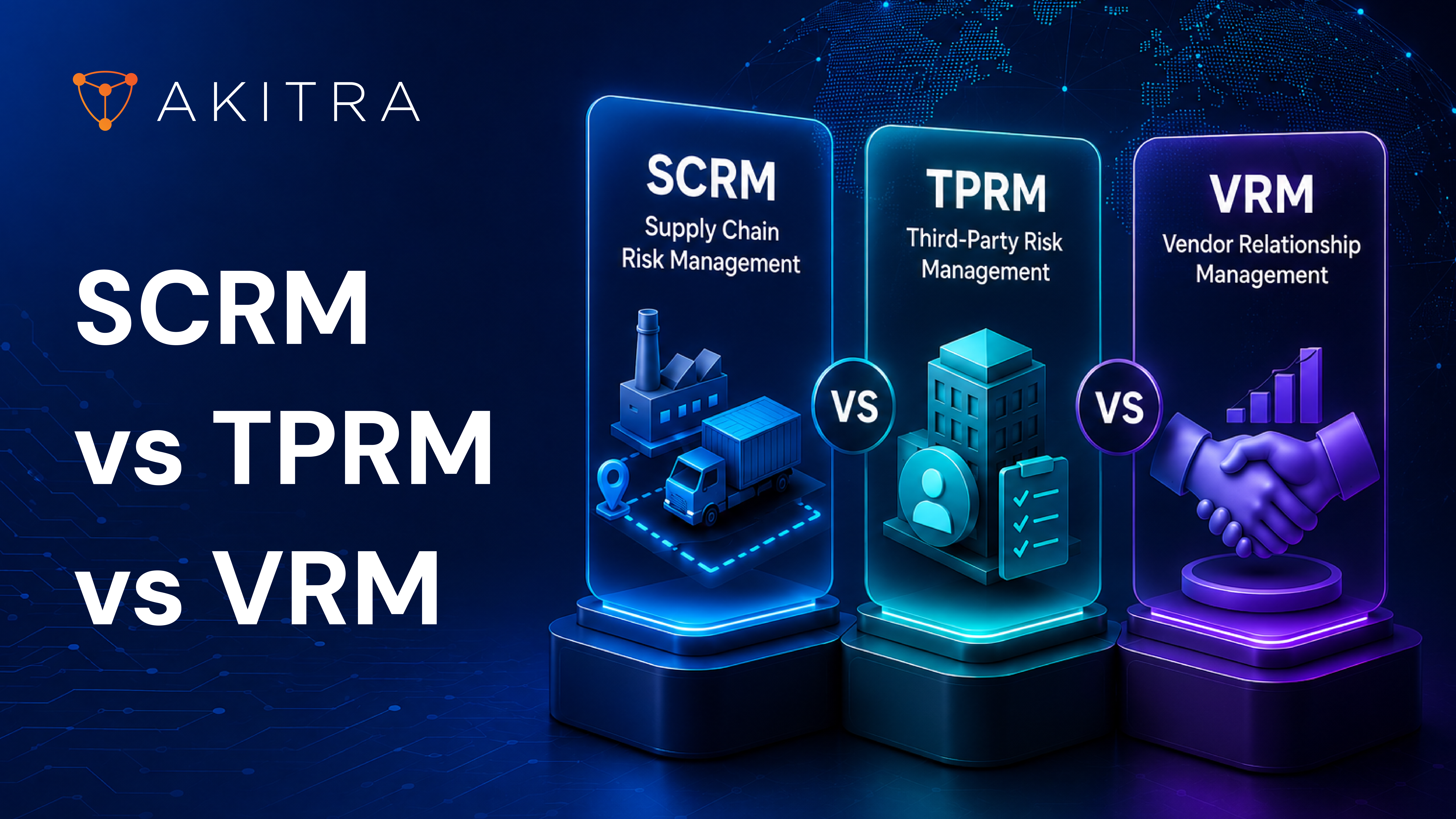
This is where Supply Chain Risk Management (SCRM), Third-Party Risk Management (TPRM), and Vendor Risk Management (VRM) come into play. Although these terms are often used interchangeably, they serve different purposes and operate at different levels of risk management.
Understanding how they differ, and how they work together, helps organizations build stronger governance, improve compliance, and reduce business disruptions.
Key Takeaways
- SCRM manages risks across the entire supply chain.
- TPRM governs risks associated with all external third parties.
- VRM focuses specifically on vendors that provide products or services.
- VRM is a subset of TPRM.
- Combining SCRM, TPRM, and VRM creates a unified third-party risk management strategy.
- AI-powered automation enables continuous monitoring, faster assessments, and improved resilience.
What Is Supply Chain Risk Management (SCRM)?
Supply Chain Risk Management (SCRM) is the process of identifying, assessing, and mitigating risks that could disrupt the movement of goods, services, and materials throughout the supply chain.
Unlike vendor-specific programs, SCRM considers the entire ecosystem, including suppliers, manufacturers, logistics providers, distributors, and even upstream dependencies.
Common Risks Managed Through SCRM
- Supply shortages
- Manufacturing disruptions
- Transportation delays
- Geopolitical instability
- ESG and sustainability risks
- Financial instability
- Cyberattacks affecting supply chain operations
- Regulatory and trade compliance
Example
A semiconductor shortage prevents your supplier from manufacturing components. Although your direct supplier remains operational, production stops because one upstream supplier fails. SCRM helps identify these dependencies before they impact your business.
What Is Third-Party Risk Management (TPRM)?
Third-Party Risk Management (TPRM) is a broader governance process for managing risks introduced by all external organizations your business works with.
These third parties may include:
- Vendors
- Suppliers
- Contractors
- Consultants
- Cloud providers
- Managed Service Providers (MSPs)
- Business partners
A mature TPRM program evaluates risk throughout the entire relationship lifecycle, from onboarding and due diligence to continuous monitoring and offboarding.
Typical TPRM Risk Categories
- Cybersecurity
- Privacy
- Regulatory compliance
- Operational resilience
- Financial health
- Business continuity
- Reputation
- Legal and contractual obligations
Frameworks commonly used include:
- NIST SP 800-161
- NIST CSF 2.0
- ISO 27001
- ISO 31000
- SOC 2
- Shared Assessments SIG
- GDPR
- HIPAA
Example
Your company uses a cloud-based payment processor. TPRM ensures the provider maintains PCI DSS compliance, encrypts payment data, conducts regular penetration testing, and has an effective incident response process.
What Is Vendor Risk Management (VRM)?
Vendor Risk Management (VRM) is a specialized subset of TPRM that focuses specifically on organizations providing products or services directly to your business.
Examples include:
- SaaS applications
- HR systems
- CRM platforms
- ERP providers
- Cloud hosting providers
- IT service providers
- Cybersecurity vendors
VRM emphasizes protecting business operations, customer data, and regulatory compliance throughout the vendor lifecycle.
A Typical Vendor Risk Management Process
- Vendor onboarding
- Due diligence
- Security questionnaires (SIG, CAIQ, custom assessments)
- Risk scoring and tiering
- Contract and SLA reviews
- Continuous monitoring
- Periodic reassessments
- Offboarding
Example
An HR department adopts a cloud payroll platform. Before onboarding, the security team reviews its SOC 2 report, encryption practices, access controls, and incident response capabilities. After implementation, the organization continuously monitors the vendor for security or compliance changes.
SCRM vs TPRM vs VRM: What’s the Difference?
Although these disciplines overlap, each addresses a different scope of third-party risk.
|
Aspect |
SCRM |
TPRM |
VRM |
|
Primary Focus |
Supply chain continuity |
All third-party relationships |
Direct vendors |
|
Main Objective |
Prevent operational disruptions |
Manage enterprise-wide external risks |
Secure vendor relationships |
|
Typical Risks |
Logistics, shortages, ESG, financial |
Cybersecurity, compliance, privacy, operational |
Data security, SLAs, compliance |
|
Ownership |
Procurement & Supply Chain |
Enterprise Risk, Security & Compliance |
IT, Security & Procurement |
|
Common Frameworks |
ISO 28000, ISO 31000 |
NIST CSF, ISO 27001, SIG |
SOC 2, ISO 27001, CAIQ |
In Simple Terms
- SCRM looks upstream to protect the supply chain.
- TPRM looks across all third-party relationships.
- VRM looks deeper into vendors that directly support your business.
These disciplines complement one another rather than compete.
How SCRM, TPRM and VRM Work Together
Rather than managing these programs separately, leading organizations integrate them into a unified third-party risk management strategy.
Think of them as three connected layers:
Supply Chain
↓
Suppliers
↓
Third Parties
↓
Vendors
↓
Continuous Monitoring
↓
Compliance & Business Resilience
This integrated approach provides complete visibility across operational, cybersecurity, financial, and compliance risks while eliminating duplicated assessments and organizational silos.
Where Does Fourth-Party Risk Fit?
Third-party risk doesn’t stop with your direct suppliers or vendors. Most third parties depend on their own suppliers, cloud providers, subcontractors, and technology partners. These indirect relationships create Fourth-Party Risk.
For example:
- Your payroll vendor may rely on another cloud hosting provider.
- A logistics partner may outsource transportation services.
- Your SaaS provider may use multiple infrastructure vendors.
If one of these indirect providers experiences a cyberattack, financial failure, or operational disruption, your organization may still be affected.
A mature risk management program should therefore monitor both third-party and fourth-party dependencies to reduce hidden supply chain and cybersecurity risks.
Best Practices for Integrating SCRM, TPRM, and VRM
1. Maintain a Centralized Third-Party Inventory
Create a single inventory of suppliers, vendors, contractors, and partners to gain complete visibility into your external ecosystem.
2. Classify Third Parties by Risk
Not every third party presents the same level of risk. Prioritize assessments based on:
- Business criticality
- Data sensitivity
- System access
- Regulatory impact
- Operational dependency
3. Standardize Risk Assessments
Use consistent methodologies while tailoring assessments for different relationship types. Examples include:
- SIG Questionnaires
- CAIQ
- ISO 27001 Controls
- NIST CSF
- Financial Due Diligence
- ESG Assessments
4. Continuously Monitor Risks
Annual assessments are no longer enough. Continuously monitor:
- Security incidents
- Compliance status
- Financial health
- External attack surface
- Certificate expirations
- Regulatory changes
Continuous monitoring helps identify emerging risks before they impact business operations.
5. Automate Risk Workflows
Manual spreadsheets cannot scale with hundreds or thousands of third parties.
Automation streamlines:
- Vendor onboarding
- Risk scoring
- Security questionnaires
- Evidence collection
- Contract reviews
- Remediation tracking
- Executive reporting
6. Strengthen Cross-Functional Collaboration
Effective risk management requires collaboration between:
- Procurement
- Information Security
- Compliance
- Legal
- Privacy
- Finance
- Business Owners
Shared ownership creates a stronger and more resilient governance model.
7. Build Risk Requirements into Contracts
Clearly define:
- Security obligations
- Incident notification timelines
- Compliance requirements
- Audit rights
- Service Level Agreements (SLAs)
- Data protection responsibilities
Akitra Insight
Organizations often classify suppliers and vendors simply as High, Medium, or Low risk. A more effective approach evaluates every relationship using five key dimensions:
|
Assessment Area |
Purpose |
|
Business Criticality |
How essential the third party is to operations |
|
Data Sensitivity |
What information they can access |
|
System Access |
Level of access to internal systems |
|
Regulatory Impact |
Compliance obligations they influence |
|
Operational Dependency |
Potential business disruption if unavailable |
This multi-dimensional approach provides more accurate risk prioritization than traditional scoring methods.
The Role of AI in Modern Third-Party Risk Management
Managing hundreds of suppliers and vendors manually is inefficient and difficult to scale.
AI-powered platforms such as Akitra Andromeda® help organizations automate critical risk management activities, including:
- Vendor onboarding and due diligence
- Security questionnaire automation
- Continuous compliance monitoring
- Risk scoring and prioritization
- Evidence collection
- Automated remediation workflows
- Executive dashboards and reporting
Instead of relying on periodic reviews, AI enables organizations to detect changes in supplier or vendor risk in near real time, improving resilience and reducing manual effort.
Conclusion
Although Supply Chain Risk Management (SCRM), Third-Party Risk Management (TPRM), and Vendor Risk Management (VRM) have different objectives, they are most effective when implemented together.
SCRM protects the physical supply chain, TPRM provides governance across all external relationships, and VRM secures direct vendor engagements. Together, they create a comprehensive risk management strategy that improves business continuity, cybersecurity, operational resilience, and regulatory compliance.
As third-party ecosystems continue to expand, organizations should move beyond siloed risk programs and adopt a unified, continuously monitored approach powered by automation and AI. This not only reduces risk but also builds stronger trust with customers, partners, and regulators.
Security, AI Risk Management, and Compliance with Akitra!
In the competitive landscape of SaaS businesses, trust is paramount amidst data breaches and privacy concerns. Akitra addresses this need with its leading Agentic AI-powered Compliance Automation platform. Our platform empowers customers to prevent sensitive data disclosure and mitigate risks, meeting the expectations of customers and partners in the rapidly evolving landscape of data security and compliance. Through automated evidence collection and continuous monitoring, paired with customizable policies, Akitra ensures organizations are compliance-ready for various frameworks such as SOC 1, SOC 2, HIPAA, GDPR, PCI DSS, ISO 27001, ISO 27701, ISO 27017, ISO 27018, ISO 9001, ISO 13485, ISO 42001, NIST 800-53, NIST 800-171, NIST AI RMF, FedRAMP, CCPA, CMMC, SOX ITGC, and more such as CIS AWS Foundations Benchmark, Australian ISM and Essential Eight etc. In addition, companies can use Akitra’s Risk Management product for overall risk management using quantitative methodologies such as Factorial Analysis of Information Risks (FAIR) and qualitative methods, including NIST-based for your company, Vulnerability Assessment and Pen Testing services, Third Party Vendor Risk Management, Trust Center, and AI-based Automated Questionnaire Response product to streamline and expedite security questionnaire response processes, delivering huge cost savings. Our compliance and security experts provide customized guidance to navigate the end-to-end compliance process confidently. Last but not least, we have also developed a resource hub called Akitra Academy, which offers easy-to-learn short video courses on security, compliance, and related topics of immense significance for today’s fast-growing companies.
Our solution offers substantial time and cost savings, including discounted audit fees, enabling fast and cost-effective compliance certification. Customers achieve continuous compliance as they grow, becoming certified under multiple frameworks through a single automation platform.
Build customer trust. Choose Akitra TODAY!To book your FREE DEMO, contact us right here.
FAQ’S
How are TPRM and VRM related?
VRM is a subset of TPRM; it focuses specifically on vendors, while TPRM includes broader third-party engagements, such as consultants or affiliates.
Why is integrating SCRM, TPRM, and VRM important?
Integration eliminates blind spots, ensures compliance, and strengthens resilience against cyber, operational, and supply disruptions.
What role does automation play in VRM and TPRM?
Automation enables continuous monitoring, faster onboarding, and instant alerts for potential risks, eliminating manual workflows.
Which frameworks support effective third-party and vendor risk management?
Standards like NIST SP 800-161, ISO 27001, SOC 2, and GDPR form the foundation for risk assessment and compliance management.