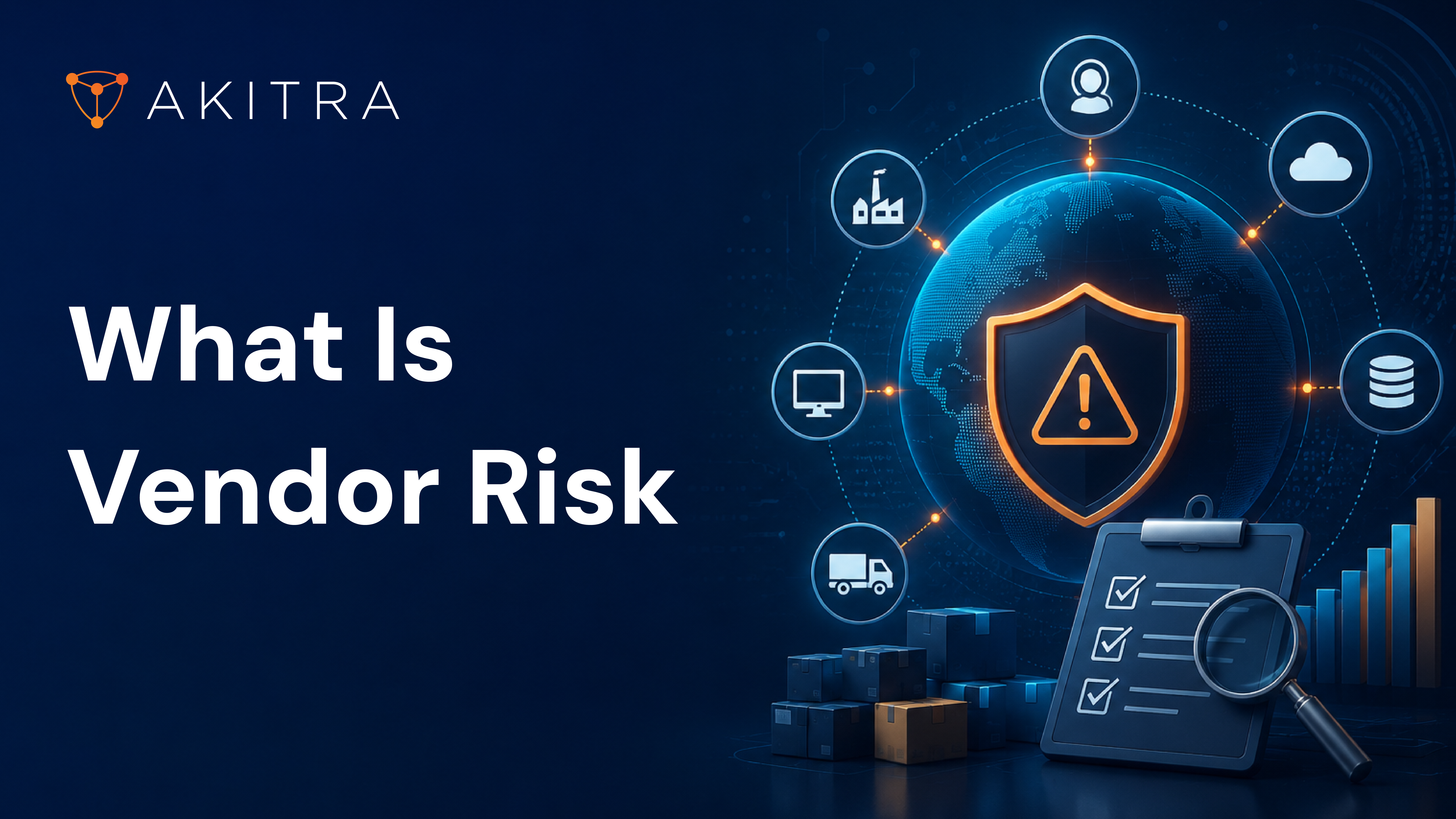
Vendor risk is the potential for a third-party vendor to expose your organization to cybersecurity, compliance, operational, financial, or reputational harm. As businesses rely more heavily on cloud providers, SaaS platforms, payment processors, consultants, and managed service providers, vendor risk has become a major part of enterprise cybersecurity.
The challenge is simple: your internal security controls may be strong, but a weak vendor can still create an entry point into your data, systems, or operations. That is why Vendor Risk Management (VRM) is now essential for protecting business continuity, compliance, and customer trust.
Key Takeaways
- Vendor risk comes from third parties that access your systems, data, or business processes.
- Cybersecurity, compliance, financial, operational, and fourth-party risks should all be assessed.
- Vendor risk should be monitored throughout the relationship, not only during onboarding.
- High-risk vendors require deeper due diligence and more frequent reassessment.
- Automation and continuous monitoring improve visibility and reduce manual effort.
What Is Vendor Risk?
Vendor risk is the exposure an organization faces because of the actions, weaknesses, or failures of third-party vendors.
These risks can arise when a vendor:
- Stores or processes sensitive data
- Has access to internal systems
- Fails to meet compliance requirements
- Experiences a cyberattack
- Suffers financial or operational instability
- Relies on insecure subcontractors
For example, your organization may use strong access controls and encryption internally, but if a third-party marketing platform stores customer data insecurely, that vendor can still create a serious security incident.
Vendor risk therefore extends your cybersecurity boundary beyond your own infrastructure.
Common Types of Vendor Risk
Vendor risk is broader than cybersecurity alone.
1. Cybersecurity Risk
Weak vendor security controls, exposed credentials, misconfigured systems, or vulnerable applications can give attackers access to your data or environment.
2. Compliance Risk
A vendor that fails to meet contractual, regulatory, or framework requirements can create compliance gaps for your organization.
This may affect standards such as:
3. Operational Risk
A critical vendor outage can interrupt your ability to deliver products or services.
4. Financial Risk
A vendor facing bankruptcy, cash-flow issues, or acquisition uncertainty may no longer be able to provide essential services.
5. Reputational Risk
Customers and regulators may still hold your organization responsible when a vendor mishandles data or experiences a public security incident.
6. Fourth-Party Risk
Your vendors often depend on their own vendors, subcontractors, and cloud providers. These indirect dependencies create additional risk that may be difficult to see.
Why Vendor Risk Can Become the Weakest Link
Organizations often invest heavily in internal security while having limited visibility into external providers. This creates several common weaknesses.
Limited Visibility
You may know which vendors you use but not how securely they manage your data or which subcontractors they depend on.
Trust Without Verification
Some businesses rely on vendor claims or certifications without validating controls, reviewing evidence, or monitoring changes over time.
Expanding Third-Party Ecosystems
As SaaS adoption grows, organizations can accumulate hundreds or thousands of vendor relationships. Manual oversight quickly becomes difficult to scale.
Shared Accountability
If a vendor causes a breach, outage, or privacy violation, the operational and regulatory impact can still fall on your organization.
Risk Changes Over Time
A vendor that was secure during onboarding may later experience a breach, lose a certification, change ownership, or introduce new infrastructure.
That is why vendor risk must be treated as a continuous process.
What Is the Business Impact of Vendor Risk?
Poor vendor oversight can affect almost every part of the organization. Potential consequences include:
- Exposure of customer or employee data
- Operational downtime
- Regulatory penalties
- Audit findings
- Contractual disputes
- Loss of customer trust
- Financial losses
- Delayed sales or procurement processes
A well-known example is the Target breach in 2013, where attackers gained access through a third-party HVAC vendor. The incident demonstrated how even a non-technical vendor relationship can create a major cybersecurity risk.
How to Identify and Manage Vendor Risk
A mature Vendor Risk Management program should follow a structured lifecycle.
1. Build a Complete Vendor Inventory
Identify every third party that provides services, accesses data, connects to systems, or supports critical operations.
2. Classify Vendors by Risk
Not every vendor requires the same level of assessment.
Consider:
- Business criticality
- Data sensitivity
- System access
- Regulatory impact
- Geographic exposure
- Financial dependency
High-risk vendors should receive deeper due diligence and more frequent monitoring.
3. Perform Vendor Risk Assessments
Use standardized questionnaires and evidence reviews to assess vendor security and compliance.
Common methods include:
- SIG questionnaires
- CSA CAIQ
- SOC 2 reports
- ISO 27001 certifications
- PCI DSS documentation
- Penetration testing reports
4. Review Contracts and Security Obligations
Contracts should define:
- Security requirements
- Data handling responsibilities
- Incident notification timelines
- Audit rights
- SLA expectations
- Subprocessor disclosure
- Offboarding requirements
5. Monitor Vendors Continuously
Annual reviews alone may leave long periods of blind spots. Continuous monitoring can help identify:
- Security incidents
- Compliance changes
- Expired certifications
- External vulnerabilities
- Financial instability
- Changes in vendor ownership
6. Reassess During Renewals and Major Changes
Trigger reassessments when contracts renew, services expand, data access changes, or a vendor experiences a material incident.
Akitra Insight: Evaluate Vendors Across Multiple Dimensions
A simple High, Medium, or Low rating can be useful, but it may not provide enough context. A stronger approach evaluates vendors across several dimensions:
|
Assessment Area |
Why It Matters |
|
Business Criticality |
Measures operational impact if the vendor fails |
|
Data Sensitivity |
Identifies exposure to regulated or confidential data |
|
System Access |
Measures the vendor’s access to applications and infrastructure |
|
Compliance Impact |
Identifies frameworks and regulatory obligations |
|
Financial Stability |
Helps assess long-term reliability |
|
Fourth-Party Dependency |
Reveals hidden downstream risks |
This creates a more accurate and business-focused risk profile.
Vendor Risk Management Lifecycle
A structured VRM lifecycle looks like this:
Vendor Identification → Risk Tiering → Due Diligence → Assessment → Approval → Continuous Monitoring → Remediation → Renewal or Offboarding
This lifecycle ensures vendor risk is managed throughout the relationship rather than only during onboarding.
Best Practices for Stronger Vendor Risk Management
To strengthen your vendor cybersecurity chain:
- Apply least-privilege access to third parties.
- Require MFA and secure authentication where possible.
- Track fourth-party and subprocessor dependencies.
- Review high-risk vendors more frequently.
- Centralize vendor documents and risk evidence.
- Align assessments with relevant compliance frameworks.
- Include vendors in incident response planning.
- Automate repetitive questionnaires and evidence reviews.
- Share vendor risk data across security, procurement, legal, and compliance teams.
The Role of AI and Automation
Manual spreadsheets and email-based reviews are difficult to scale as vendor ecosystems grow.
AI-powered Vendor Risk Management platforms can help automate:
- Vendor onboarding
- Security questionnaires
- Evidence collection
- Risk scoring
- Continuous monitoring
- Remediation workflows
- Compliance tracking
- Executive reporting
Platforms such as Akitra Andromeda® Vendor Risk Management use Agentic AI to help organizations identify changes faster, reduce repetitive work, and maintain a more continuous view of vendor risk.
Conclusion
Vendor risk is no longer a secondary compliance issue. It is a core cybersecurity and resilience concern because every third-party relationship expands your organization’s security boundary.
The strongest Vendor Risk Management programs go beyond onboarding assessments. They classify vendors based on business impact, continuously monitor changing risks, evaluate fourth-party dependencies, and integrate security, procurement, legal, and compliance teams.
By combining structured governance with automation and continuous monitoring, organizations can reduce third-party blind spots and ensure vendors strengthen rather than weaken their cybersecurity posture.
Security, AI Risk Management, and Compliance with Akitra!
In the competitive landscape of SaaS businesses, trust is paramount amidst data breaches and privacy concerns. Akitra addresses this need with its leading Agentic AI-powered Compliance Automation platform. Our platform empowers customers to prevent sensitive data disclosure and mitigate risks, meeting the expectations of customers and partners in the rapidly evolving landscape of data security and compliance. Through automated evidence collection and continuous monitoring, paired with customizable policies, Akitra ensures organizations are compliance-ready for various frameworks such as SOC 1, SOC 2, HIPAA, GDPR, PCI DSS, ISO 27001, ISO 27701, ISO 27017, ISO 27018, ISO 9001, ISO 13485, ISO 42001, NIST 800-53, NIST 800-171, NIST AI RMF, FedRAMP, CCPA, CMMC, SOX ITGC, and more such as CIS AWS Foundations Benchmark, Australian ISM and Essential Eight etc. In addition, companies can use Akitra’s Risk Management product for overall risk management using quantitative methodologies such as Factorial Analysis of Information Risks (FAIR) and qualitative methods, including NIST-based for your company, Vulnerability Assessment and Pen Testing services, Third Party Vendor Risk Management, Trust Center, and AI-based Automated Questionnaire Response product to streamline and expedite security questionnaire response processes, delivering huge cost savings. Our compliance and security experts provide customized guidance to navigate the end-to-end compliance process confidently. Last but not least, we have also developed a resource hub called Akitra Academy, which offers easy-to-learn short video courses on security, compliance, and related topics of immense significance for today’s fast-growing companies.
Our solution offers substantial time and cost savings, including discounted audit fees, enabling fast and cost-effective compliance certification. Customers achieve continuous compliance as they grow, becoming certified under multiple frameworks through a single automation platform.
Build customer trust. Choose Akitra TODAY!To book your FREE DEMO, contact us right here.
FAQ’S
Why are vendor risk management mistakes so common?
They occur because many companies view vendor risk as a compliance checklist rather than a continuous security function. Lack of automation and siloed processes further increase human error.
How can automation help reduce vendor risk management mistakes?
Automation platforms like Akitra Andromeda® continuously collect, analyze, and update vendor data — minimizing manual work and ensuring no vendor risk goes unnoticed.
How often should I reassess my vendors?
High-risk vendors should be reviewed quarterly or bi-annually, while low-risk vendors can be assessed annually. Automation ensures timely re-assessments without extra administrative effort.
What’s the best way to start improving my vendor risk management program?
Start by identifying critical vendors, classifying them by risk, and adopting an automated solution like Akitra Andromeda® that integrates compliance, risk scoring, and reporting in one unified platform.