Managing third-party risk has become a strategic priority for organizations in 2026. Businesses rely on suppliers for products and raw materials, while vendors provide software, cloud services, logistics, consulting, and other business-critical capabilities. A disruption or security incident affecting either can lead to operational downtime, financial loss, compliance violations, and reputational damage.
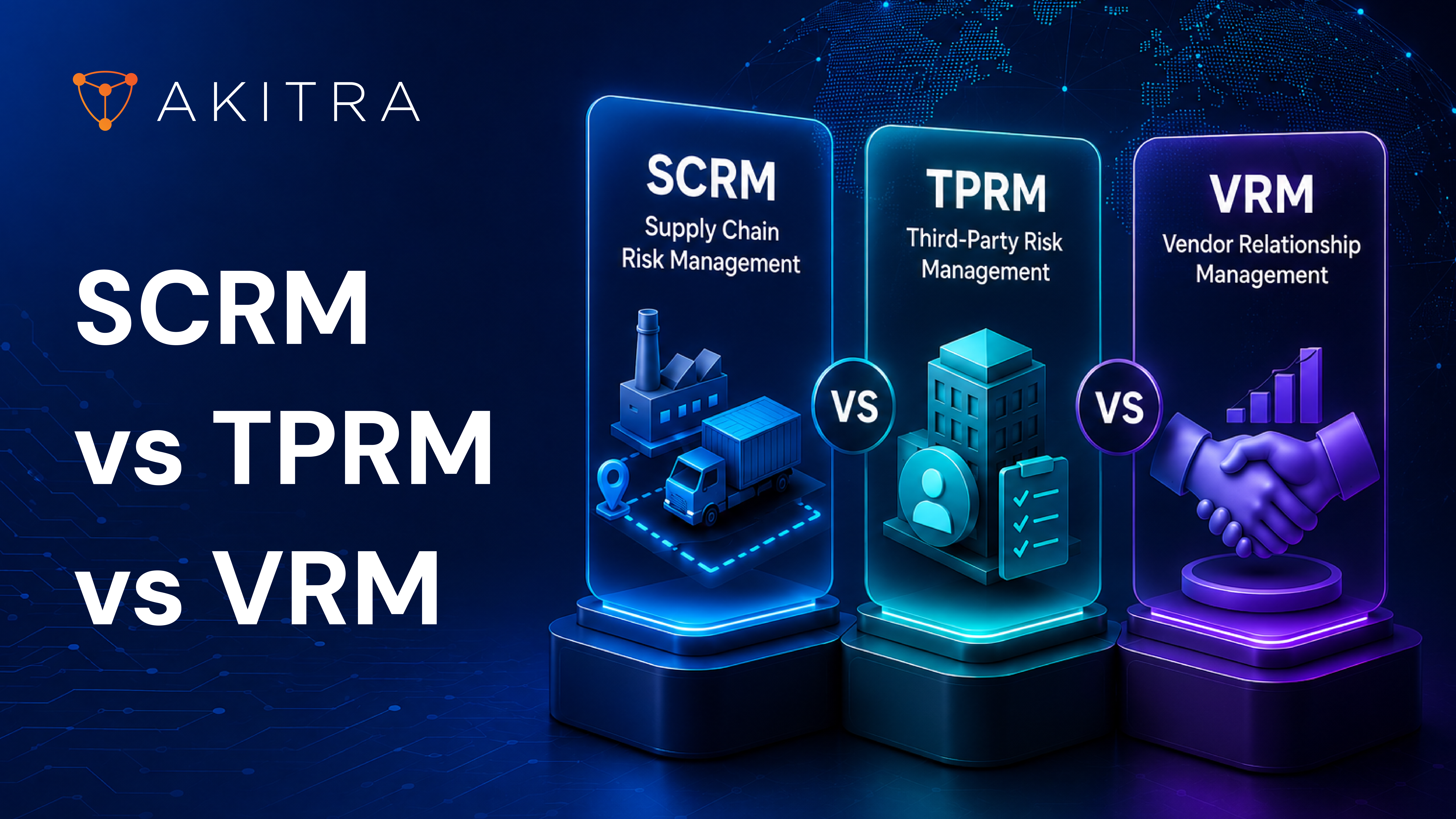
Although Supplier Risk Management (SRM) and Vendor Risk Management (VRM) are often used interchangeably, they address different categories of third-party risk. Understanding the distinction and integrating both into a unified governance strategy helps organizations improve resilience, strengthen compliance, and reduce enterprise-wide risk.
Key Takeaways
- Supplier Risk Management focuses on risks related to the physical supply chain.
- Vendor Risk Management focuses on cybersecurity, compliance, privacy, and digital service providers.
- Both are essential components of a broader Third-Party Risk Management (TPRM) strategy.
- Continuous monitoring provides greater visibility than periodic assessments.
- AI-powered automation improves vendor onboarding, risk scoring, evidence collection, and remediation.
- Organizations that unify SRM and VRM achieve stronger operational resilience and faster regulatory compliance.
What Is Supplier Risk Management?
Supplier Risk Management (SRM) is the process of identifying, assessing, monitoring, and mitigating risks associated with organizations that supply goods, raw materials, manufacturing components, or logistics services.
Its primary objective is to ensure supply chain continuity while minimizing operational, financial, and reputational disruptions.
Typical supplier risks include:
- Production delays
- Inventory shortages
- Financial instability
- Quality failures
- ESG violations
- Geopolitical disruptions
- Natural disasters
- Cybersecurity incidents affecting manufacturing partners
Examples
- A manufacturer relying on a single overseas semiconductor supplier.
- A pharmaceutical company sourcing ingredients from multiple countries.
- A retailer depending on logistics providers during seasonal demand.
What Is Vendor Risk Management?
Vendor Risk Management (VRM) focuses on managing risks introduced by third-party service providers that access organizational systems, networks, applications, or sensitive information.
These vendors often include:
- SaaS providers
- Cloud platforms
- Managed Service Providers (MSPs)
- Payroll providers
- CRM and ERP vendors
- Cybersecurity vendors
- Payment processors
The primary goal of VRM is to protect confidentiality, integrity, availability, and regulatory compliance throughout the vendor lifecycle.
Common vendor risks include:
- Data breaches
- Unauthorized access
- Regulatory non-compliance
- Service outages
- Third-party cyberattacks
- Poor security controls
- Weak incident response
Supplier Risk Management vs. Vendor Risk Management
Although both disciplines deal with external relationships, their priorities differ.
|
Aspect |
Supplier Risk Management |
Vendor Risk Management |
|
Primary Focus |
Supply chain continuity |
Information security & compliance |
|
Third Party Type |
Manufacturers, distributors, logistics |
SaaS, cloud, IT, MSPs |
|
Main Risks |
Operational, financial, ESG, logistics |
Cybersecurity, privacy, compliance |
|
Business Owner |
Procurement & Supply Chain |
Security, IT & Compliance |
|
Assessment Methods |
Supplier audits, quality reviews, financial analysis |
Security questionnaires, SOC 2, ISO 27001, penetration testing |
|
Key Metrics |
Delivery performance, supplier quality, financial health |
Risk score, security posture, SLA compliance |
|
Monitoring |
Inventory, production, geopolitical events |
Continuous security monitoring, vulnerabilities, compliance |
Simply put:
- SRM protects products and operations.
- VRM protects systems, data, and digital trust.
How Supplier Risk and Vendor Risk Work Together
Modern organizations rarely separate physical and digital ecosystems.
For example:
- A manufacturing supplier may use cloud systems to manage production.
- A logistics partner may process sensitive customer information.
- A software vendor may support manufacturing operations.
This overlap means that supplier disruptions can create cybersecurity issues, while vendor incidents can disrupt operations.
Organizations therefore benefit from managing both under a unified Third-Party Risk Management (TPRM) program.
Why Align Supplier Risk Management and Vendor Risk Management?
Combining SRM and VRM provides several advantages.
Better Enterprise Visibility
A centralized inventory of suppliers and vendors gives leadership complete visibility into third-party exposure.
Stronger Regulatory Compliance
Unified governance supports compliance with:
- ISO 27001
- NIST CSF
- SOC 2
- PCI DSS
- HIPAA
- GDPR
- DORA
- NIS2
Faster Incident Response
Shared risk intelligence enables security, procurement, legal, and compliance teams to respond more quickly.
Improved Business Continuity
Organizations can identify critical third parties before disruptions affect customers.
Best Practices for Aligning SRM and VRM
1. Build a Centralized Third-Party Inventory
Maintain one inventory covering suppliers, vendors, contractors, and partners.
Capture:
- Business criticality
- Data access
- Contract details
- Compliance status
- Risk ownership
2. Standardize Risk Assessments
Use consistent scoring criteria while allowing assessments to vary by relationship type.
Examples include:
- SIG questionnaires
- CAIQ
- ISO 27001 controls
- NIST CSF
- Financial health assessments
- ESG scorecards
3. Classify Third Parties by Risk
Rather than treating every organization equally, classify them based on:
- Business criticality
- Data sensitivity
- Regulatory impact
- Operational dependency
- Network access
This enables teams to prioritize high-risk relationships.
4. Continuously Monitor Third Parties
Annual assessments are no longer sufficient.
Monitor continuously for:
- Security incidents
- Financial changes
- Compliance violations
- Breach notifications
- External attack surface changes
- Certificate expirations
5. Automate Workflows
Automation reduces manual effort by streamlining:
- Vendor onboarding
- Security questionnaires
- Risk scoring
- Evidence collection
- Contract reviews
- Remediation tracking
- Executive reporting
6. Improve Cross-Functional Collaboration
Successful third-party risk programs involve:
- Procurement
- Security
- Compliance
- Legal
- Privacy
- Finance
- Business owners
Shared ownership improves accountability and decision-making.
7. Include Risk Requirements in Contracts
Contracts should define:
- Security requirements
- Audit rights
- Incident notification timelines
- SLA expectations
- Compliance obligations
- Data protection responsibilities
Akitra Insight
Organizations often classify third parties only as High, Medium, or Low risk. A more effective approach evaluates each relationship across five dimensions:
- Business Criticality
- Data Sensitivity
- System Access
- Regulatory Impact
- Operational Dependency
This creates a more accurate, business-driven view of third-party risk and helps prioritize remediation efforts.
The Role of AI in Third-Party Risk Management
Modern third-party ecosystems generate thousands of risk signals every day. AI-powered platforms help organizations:
- Automate vendor onboarding
- Continuously monitor suppliers and vendors
- Detect emerging risks
- Prioritize remediation
- Generate audit-ready evidence
- Produce executive dashboards
- Improve decision-making through predictive analytics
Instead of reacting to annual assessments, organizations gain continuous visibility into changing third-party risks.
Benefits of a Unified Third-Party Risk Strategy
Organizations that align SRM and VRM gain:
- End-to-end visibility across suppliers and vendors
- Reduced operational and cybersecurity risks
- Faster compliance with regulatory frameworks
- Better audit readiness
- Improved supplier and vendor performance
- Stronger business continuity
- Increased stakeholder trust
Conclusion
Supplier Risk Management and Vendor Risk Management solve different problems, but together they create a stronger foundation for enterprise resilience.
Supplier Risk Management protects the physical supply chain by addressing operational, financial, and logistical risks. Vendor Risk Management protects the digital ecosystem by reducing cybersecurity, privacy, and compliance risks.
As organizations expand their third-party ecosystems, managing these disciplines separately creates blind spots. A unified third-party risk management strategy supported by continuous monitoring, automation, and AI enables organizations to strengthen resilience, improve compliance, and make better risk-based decisions.
Security, AI Risk Management, and Compliance with Akitra!
In the competitive landscape of SaaS businesses, trust is paramount amidst data breaches and privacy concerns. Akitra addresses this need with its leading Agentic AI-powered Compliance Automation platform. Our platform empowers customers to prevent sensitive data disclosure and mitigate risks, meeting the expectations of customers and partners in the rapidly evolving landscape of data security and compliance. Through automated evidence collection and continuous monitoring, paired with customizable policies, Akitra ensures organizations are compliance-ready for various frameworks such as SOC 1, SOC 2, HIPAA, GDPR, PCI DSS, ISO 27001, ISO 27701, ISO 27017, ISO 27018, ISO 9001, ISO 13485, ISO 42001, NIST 800-53, NIST 800-171, NIST AI RMF, FedRAMP, CCPA, CMMC, SOX ITGC, and more such as CIS AWS Foundations Benchmark, Australian ISM and Essential Eight etc. In addition, companies can use Akitra’s Risk Management product for overall risk management using quantitative methodologies such as Factorial Analysis of Information Risks (FAIR) and qualitative methods, including NIST-based for your company, Vulnerability Assessment and Pen Testing services, Third Party Vendor Risk Management, Trust Center, and AI-based Automated Questionnaire Response product to streamline and expedite security questionnaire response processes, delivering huge cost savings. Our compliance and security experts provide customized guidance to navigate the end-to-end compliance process confidently. Last but not least, we have also developed a resource hub called Akitra Academy, which offers easy-to-learn short video courses on security, compliance, and related topics of immense significance for today’s fast-growing companies.
Our solution offers substantial time and cost savings, including discounted audit fees, enabling fast and cost-effective compliance certification. Customers achieve continuous compliance as they grow, becoming certified under multiple frameworks through a single automation platform.
Build customer trust. Choose Akitra TODAY!To book your FREE DEMO, contact us right here.
FAQ’S
How is supplier risk management different from vendor risk management?
Supplier risk management focuses on supply chain continuity, while vendor risk management targets digital, SaaS, and IT service providers managing sensitive data.
Why should businesses align supplier and vendor risk management?
Because modern operations depend on both physical and digital ecosystems, aligning both ensures end-to-end resilience, compliance, and visibility.
How does automation help in supplier risk management?
Automation tools help monitor supplier performance, detect early warning signs, and integrate real-time risk data, minimizing manual oversight.
What tools can help manage both supplier and vendor risks?
Platforms like Akitra Andromeda® Vendor Risk Management, powered by Agentic AI, unify both SRM and VRM processes under a single, continuous monitoring framework.